Welcome to Our Safari!
What a wild adventure these past seven weeks have been!
On September 14th, Tatianna welcomed nine tiny explorers into the world, and just like that, our safari began! Flamingo, Hippo, Cheetah, Zebra, Giraffe, Elephant, Rhino, Lion, and Meerkat arrived with their eyes closed, their ears sealed, and absolutely no idea of the adventures waiting beyond their whelping box.
Seven weeks later, our little explorers have certainly found their wild side! They're curious, adventurous, occasionally mischievous, and developing personalities every bit as unique as the animals they're named after.
And goodness, have they covered some ground!
Our expedition began with Early Neurological Stimulation (ENS) and Early Scent Introduction (ESI). As their senses awakened, their territory expanded. New surfaces to navigate, strange objects to investigate, obstacles to conquer, unfamiliar sounds to decipher, and countless opportunities to discover just how capable those four little paws could be.
Following our Puppy Culture curriculum, we've allowed developmental milestones to guide the journey. Some adventures called for encouragement, others required patience, and sometimes the most valuable thing I could do was stand back and let a puppy figure out the trail for themselves.
The goal was never to eliminate every bump along the way. It was to give these puppies the confidence, resilience, and problem-solving skills to navigate unfamiliar territory.
And if there's one thing I've learned traveling alongside these nine explorers, it's that no two puppies take quite the same path!
Present the same challenge to nine puppies, and you'll discover nine different approaches. Some are fearless trailblazers, charging ahead without hesitation. Others are thoughtful observers, surveying the landscape before making their move. Some are determined adventurers who refuse to give up, while others quickly discover that recruiting a human expedition partner might be the easiest solution!
Those differences aren't shortcomings. They're valuable clues about each puppy's emerging personality and the type of home where they're most likely to thrive.
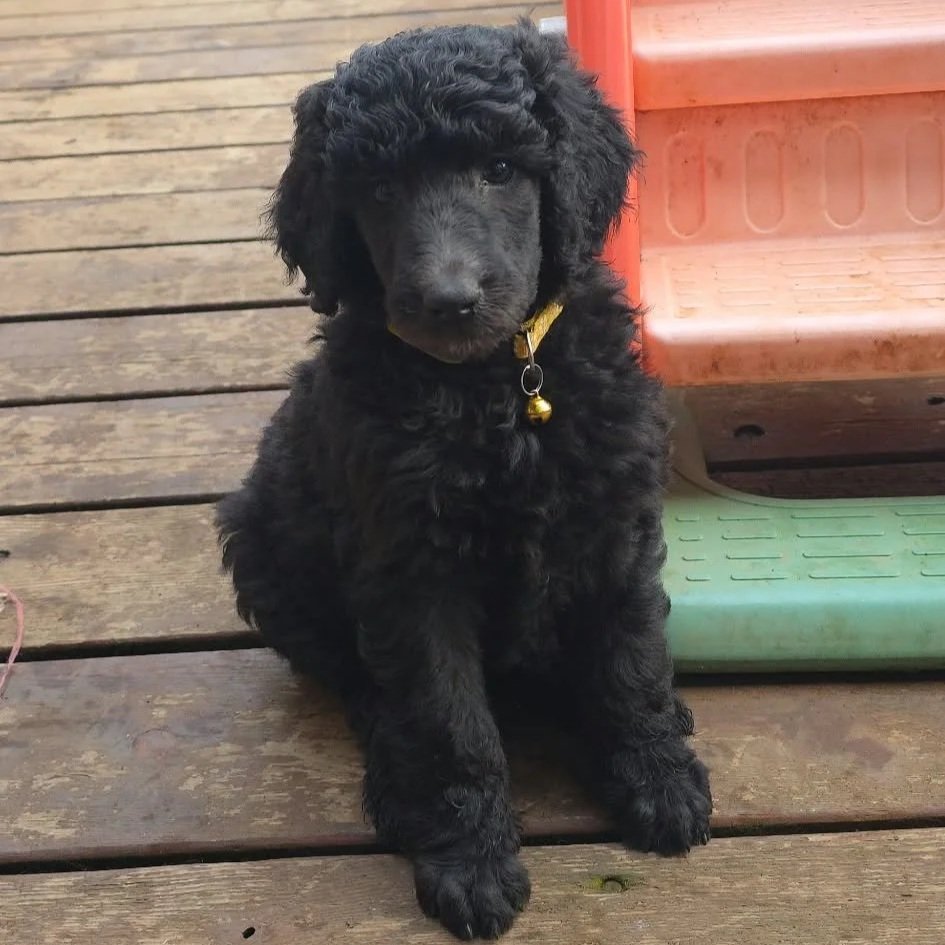
The Next Expedition: Pick Your Puppy!
You've spent the past seven weeks following our safari as a group. Now it's time to open the field notes, take a closer look at our explorers, and discover which one might be the perfect companion for your own adventures.
Consider this page your Safari Field Guide.
Inside, you'll find each puppy's temperament evaluation, videos, my personal observations, and recommendations about the homes and lifestyles where I believe each puppy will be most successful.
Formal temperament testing allows us to observe how each puppy navigates unfamiliar territory, responds to surprises, approaches challenges, seeks human interaction, and recovers from unexpected experiences.
But even the best field guide can't tell you everything about an explorer from a single expedition!
These are seven-week-old puppies, still growing and discovering the world. Their evaluations provide valuable information, but they're only one piece of a much larger picture.
I've spent seven weeks watching these puppies conquer obstacles, work through frustration, interact with their littermates, develop new skills, and grow more confident. Those everyday observations, combined with their temperament evaluations and structural development, help guide my placement recommendations.
Finding Your Adventure Partner
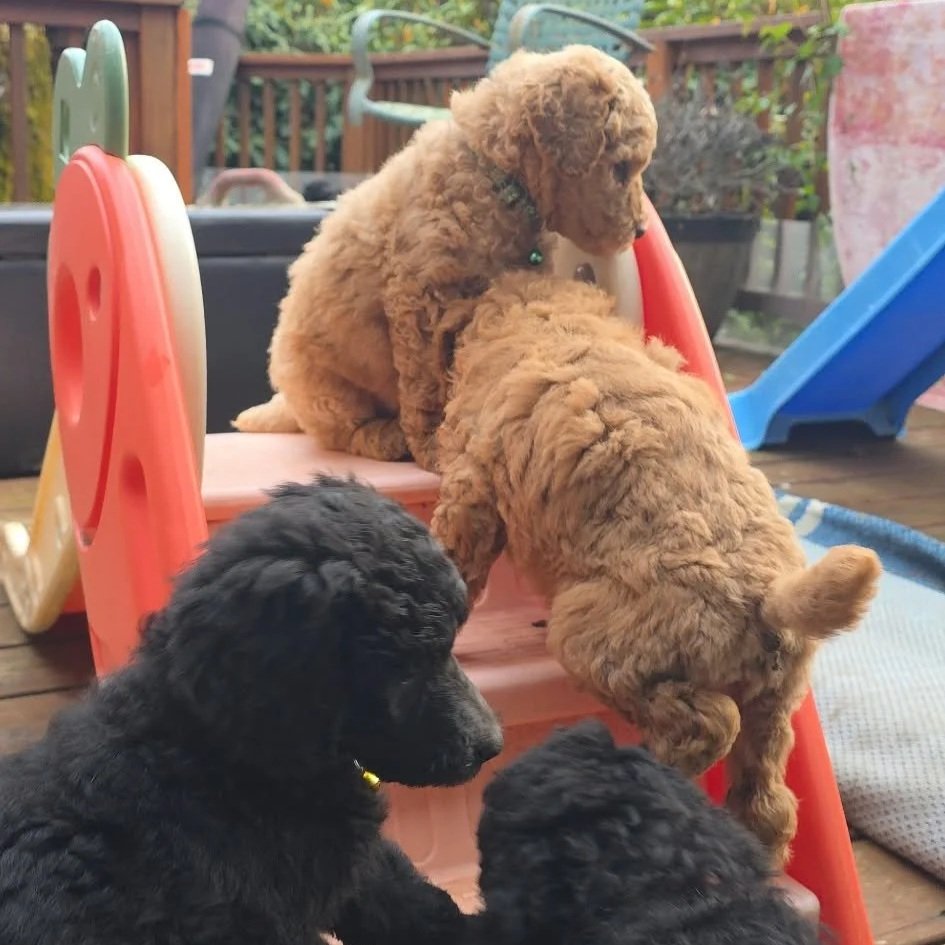
As you explore each puppy's profile, I encourage you to keep an open mind.
It's easy to fall in love with a particular face, favorite name, or the puppy who's captured your attention in photographs. But the explorer who first catches your eye isn't necessarily the one best suited to travel alongside you for the next 12 to 15 years.
Think about the adventures you want to share. Are you looking for an enthusiastic trail companion who's always ready to explore? A clever partner who loves learning and tackling challenges? Or an easygoing explorer who's equally happy adventuring and relaxing at home?
There isn't one best puppy on this safari. There are nine individuals with their own strengths, personalities, and ways of navigating the world.
My goal is to help you look beyond appearances and find the companion whose temperament and needs are most compatible with your lifestyle.
After all, the best adventures aren't about finding the boldest explorer. They're about finding the right one to share the journey.
Thank you for trusting me to guide these nine little explorers through their first adventures. Watching them discover their world has been a privilege, and now comes the exciting part—helping each find the family who will accompany them on all the adventures still to come.
The trail ahead is yours to explore. Your safari companion is waiting!

Temperament is about so much more than a single test. Throughout our safari, we've spent weeks observing each puppy as they explore new territory, navigate challenges, interact with people and littermates, and discover the world around them. These everyday adventures give us valuable insight into their confidence, curiosity, motivation, recovery, problem-solving abilities, and individual personalities.
Each new experience adds another piece to the puzzle, helping us understand not just how a puppy responds in one moment, but how they approach life as a whole.
This is a lengthy Pupdate, packed with important information about our nine little explorers, so please take your time working through the field notes, evaluations, and recommendations before making your selection.
Once all reservation holders have completed their selections, we'll update the Available Puppies page with any remaining puppies.
We're also keeping an eye out for the right co-owner or guardian home for a potential show prospect from this litter. If you've ever been interested in conformation, performance sports, or becoming more involved with our breeding program, we'd love to explore whether this opportunity might be a good fit.
After puppy selections are finalized, we'll begin following up with families who have been waiting for availability updates, as well as applicants who may be better suited for one of our upcoming litters.
Now, let's open the field guide and get to know our safari explorers!

Click the binoculars to explore the complete temperament evaluation spreadsheet, including scoring, observation notes, and individual results for each of our nine Safari explorers.
Decoding the Field Notes: Understanding Temperament Evaluations
Alright… so you've opened our Safari Field Guide, taken one look at that spreadsheet, and thought:
"Whoa… what exactly am I looking at?!"
Fair enough!
There's a lot of information packed into those field notes, and deciphering all those numbers, categories, and observations might feel a little like trying to navigate the African savanna without a map.
But don't worry. You don't need to be an expert tracker to find your perfect adventure companion!
Over the next few sections, I'll help you navigate the evaluations, explain what we're measuring, and show you how to interpret the results. More importantly, we'll explore how those scores translate into everyday life and what they might mean for your future puppy.
Remember, a temperament evaluation is a snapshot, not a crystal ball. My recommendations are based on much more than a single testing session. They're informed by seven weeks of traveling alongside these little explorers, watching how they learn, recover, solve problems, interact with their world, and develop their individual personalities.
Think of the spreadsheet as your map, the evaluations as your field notes, and my recommendations as your experienced safari guide helping you make sense of it all.
Ready? Let's follow the trail!
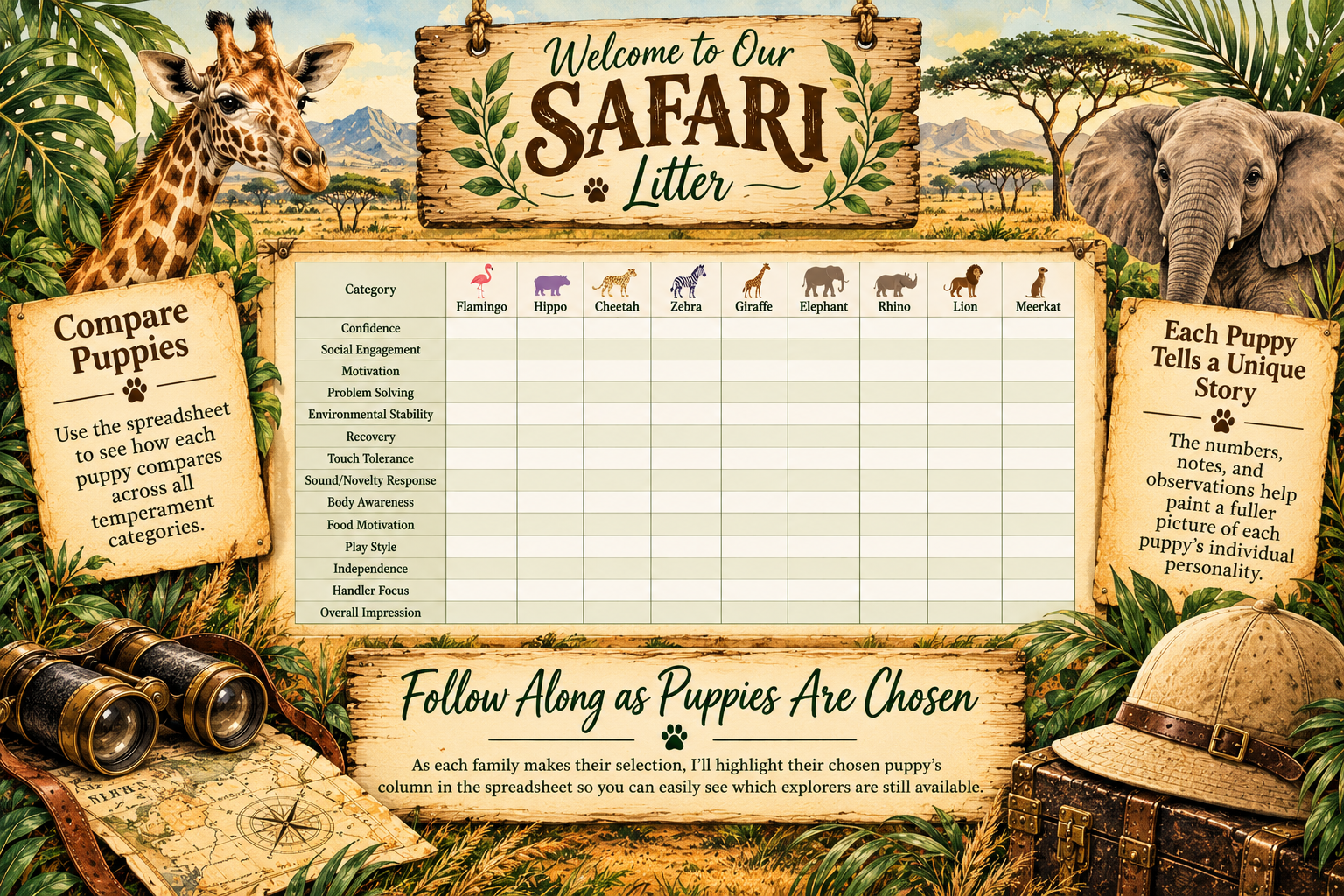
Learn how to navigate the Safari Litter temperament evaluation spreadsheet, compare Tatianna and Magic's nine little explorers side-by-side, and follow along as families make their selections to see which puppies are still available.
Learn how to interpret the temperament evaluation results for Tatianna and Magic's nine safari explorers, and discover how their scores, individual observations, and seven weeks of development help us identify the best match for each family.
Puppy Evaluations
Every explorer approaches unfamiliar territory a little differently, and our temperament evaluations are designed to help us understand those differences.
Our evaluations provide insight into how each puppy naturally interacts with the world while respecting their emotional development, autonomy, and trust.
Rather than putting puppies through rigid or unnecessarily stressful testing, we focus on observing their confidence, engagement, recovery, problem-solving abilities, environmental stability, adaptability, and workability.
Throughout the evaluation, puppies encounter unfamiliar environments, surfaces, objects, handling, and challenges. We're interested not only in what they do, but how they approach an experience, what motivates them, and how they respond when something doesn't go quite as expected.
The goal isn't to manufacture stress or see how much a puppy can tolerate. It's to give them opportunities to explore unfamiliar territory while allowing their natural personalities and developing skills to emerge.
Over the years, I've found this approach provides a more complete and realistic picture of each puppy while remaining consistent with our Puppy Culture philosophy.
How Is the Evaluation Performed?
Every expedition begins with a little exploration.
The evaluator starts seated quietly in the testing area while the puppy is brought into the unfamiliar environment and given time to settle in.
During these first moments, the puppy is free to investigate their surroundings, explore toys, interact with the evaluator, or simply sit back and take everything in.
There's no rush to get started. How a puppy chooses to approach unfamiliar territory can tell us quite a bit before we've even introduced the first activity.
Once the puppy is comfortable, we gradually introduce different experiences, including:
Toy engagement and play
Problem-solving challenges
Navigating obstacles and equipment
Exploring novel and unstable surfaces
Recovery from unexpected experiences
Handling and grooming tolerance
Environmental adaptability
The evaluation is intentionally flexible rather than rigidly scripted. We follow the puppy's responses, allowing opportunities for encouragement, exploration, and independent decision-making.
One of the most important things to understand is that our puppies always have a choice.
A puppy might tell us:
"I'm not sure about that."
"Give me a minute to figure this out."
Or even, "No thanks. Not interested!"
And that's okay!
We may encourage, guide, coax, or coach a puppy through a challenge, but we don't force participation. Sometimes a puppy's decision to avoid an activity tells us just as much as watching another puppy confidently tackle it.
If a puppy becomes overwhelmed, we can pause, give them time to recover, or end the evaluation altogether. Their emotional well-being always comes first.
We're not looking for puppies who blindly complete every task. We're looking to understand how each explorer thinks, responds, communicates, and navigates the world.
There are no passing or failing grades on this safari.
Traits Evaluated
Our temperament evaluations consider both relatively stable developmental tendencies and characteristics that can be influenced by experience, environment, training, and maturity.
Each trait is scored on a scale of 1–5, but it's important to remember that a higher number doesn't automatically mean a better puppy. Different traits and combinations of traits are desirable for different homes and purposes.
Stable Traits
Scored from 1–5, with 5 representing a higher expression of the trait.
Assertiveness with humans
Assertiveness with other dogs
Motivation
Energy level
Intensity
Human focus
Tenderheartedness
Adjustable Traits
Scored from 1–5, with 5 representing a higher expression of the trait.
Confidence
Nerve strength / resiliency
Touch tolerance (compliance, not necessarily enjoyment)
Sensitivity Traits
These categories use a sensitivity scale:
1 = Little to no sensitivity
5 = High sensitivity
Sound sensitivity
Sight sensitivity
Remember, these scores are not a ranking of our nine explorers from best to worst. They're simply another set of field notes helping us understand what makes each puppy unique.
A confident, highly motivated, intense puppy may be an exciting prospect for an experienced performance home, while a more moderate, easygoing puppy may be a wonderful match for a family looking for a companion.
The goal isn't to find the puppy with the highest scores. It's to find the puppy whose combination of traits makes them the right adventure partner for you.

Learn what each temperament trait reveals about Tatianna and Magic's nine Safari explorers, why those characteristics matter, and how their individual strengths and personalities help us find the right adventure companion for each family.
Definitions & Understanding the Traits
Human Assertiveness
Human assertiveness is not aggression. It describes how readily a puppy approaches people, initiates interaction, and makes themselves part of whatever you're doing.
Our more assertive explorers are often the puppies who:
Climb straight into your lap without an invitation.
Enthusiastically greet new people.
Insist on investigating everything you're doing.
Would happily steal your pizza if you weren't paying attention!
These puppies tend to be socially confident, outgoing, and very comfortable inserting themselves into human activities.
Higher human assertiveness can be particularly valuable in certain working roles, including diabetic alert, psychiatric service work, and behavior interruption tasks, where a dog may need to initiate interaction independently.
Of course, there's a flip side! These enthusiastic little explorers need consistent boundaries and guidance as they mature. Without it, their eagerness to engage can turn into jumping, pushiness, or difficulty controlling their impulses.
The takeaway: A highly assertive puppy may be a wonderful partner for someone who enjoys an outgoing, interactive dog, but they also need a family willing to teach appropriate manners.
Prey Drive / Intensity
When people hear "prey drive," they often picture a dog chasing squirrels or cats. But there's much more to it than that!
For our evaluations, we're looking at the intensity with which a puppy engages with toys, movement, play, and other stimulating experiences.
You might see this in a puppy who:
Becomes completely focused on a moving toy.
Enthusiastically grabs, tugs, or shakes toys.
Loves chasing and interactive games.
Remains engaged even when a task becomes challenging.
Has a particularly enthusiastic, all-in approach to play.
Higher-intensity dogs can be exciting partners for performance sports, scent work, advanced training, and other activities that provide appropriate outlets for their energy and motivation.
However, intensity isn't automatically the same thing as trainability, and more isn't always better.
These dogs often need help learning when to engage, when to disengage, and how to settle when the adventure is over.
The takeaway: A high-intensity explorer can be a fantastic match for an active, training-oriented home, while a puppy with more moderate intensity may be easier to live with for a family seeking a relaxed companion.
Nerve Strength / Resiliency
Every good explorer encounters unfamiliar territory. What matters isn't necessarily whether something surprises them, but how they respond afterward.
Nerve strength and resiliency describe a puppy's ability to navigate uncertainty, adapt to new environments, and recover from experiences that may initially cause hesitation.
We're observing things like:
How quickly a puppy recovers after being startled.
Their willingness to investigate unfamiliar objects.
How they approach new surfaces or environmental challenges.
Whether they regain confidence after something unexpected.
How readily they return to exploring or engaging.
This is considered an adjustable trait, meaning experience, environment, training, and continued confidence-building can influence its development.
A puppy who needs a little more encouragement at seven weeks isn't necessarily going to be an insecure adult dog. Likewise, a particularly bold puppy still needs thoughtful socialization and positive experiences.
Our Puppy Culture curriculum is built around helping puppies develop these skills, but that work doesn't end when they leave Valaurah Farms.
The takeaway: Resiliency is an important consideration for any home, particularly those expecting a dog to regularly navigate busy, unpredictable, or unfamiliar environments.
Tenderheartedness
Tenderheartedness is one of the more interesting traits we evaluate, and one that families don't always think about when choosing a puppy.
It describes how sensitive and responsive a puppy appears to be toward human emotions, tone, and social interactions.
Our more tenderhearted explorers may be especially responsive to changes in someone's voice, body language, or emotional energy.
These dogs often develop incredibly close relationships with their people and may be particularly attentive to subtle changes in their environment.
Tenderheartedness can be a desirable quality in companion dogs and certain therapy or support roles, although it doesn't independently determine suitability for those jobs.
There are also some important considerations.
A highly emotionally sensitive dog may find a household with frequent yelling, unpredictable interactions, or intense emotional activity more challenging than a dog who is naturally less affected by those experiences.
That doesn't mean tenderhearted dogs can't live in busy families or alongside people experiencing anxiety, PTSD, or other emotional challenges. It means we need to consider the individual dog's coping skills, resilience, and comfort with that environment.
The takeaway: Tenderheartedness can contribute to a wonderfully connected relationship, but the right match depends on how that sensitivity combines with the puppy's confidence, resiliency, and other traits.
Touch Tolerance
Touch tolerance is particularly important for Standard Poodles, considering how much grooming and handling they'll experience throughout their lives!
This trait isn't simply about whether a puppy enjoys being touched. We're looking at how they respond when handling becomes inconvenient, unfamiliar, or mildly uncomfortable.
Some puppies are remarkably easygoing and seem perfectly content with nearly everything we do.
Others may communicate their discomfort by:
Pulling away or repositioning themselves.
Becoming still or hesitant.
Wiggling, resisting, or attempting to leave.
Showing signs that they need a break.
Those responses provide valuable information about the puppy's comfort level and communication style.
It's important to distinguish between a puppy who genuinely enjoys handling and one who simply tolerates it. A puppy who remains still isn't necessarily relaxed, and compliance shouldn't automatically be interpreted as comfort.
Touch tolerance is especially relevant for grooming, veterinary care, cooperative husbandry, and households with children.
We've already introduced our puppies to regular grooming and daily handling, but continued positive experiences will be important as they mature.
The takeaway: A puppy with lower touch tolerance isn't necessarily a poor companion. They may simply need a more deliberate approach to cooperative care, handling, and building trust.
Putting the Field Notes Together
As you work through these definitions, remember that no single trait tells the entire story of a puppy.
A highly assertive puppy with excellent resiliency may navigate the world very differently from an equally assertive puppy who is more environmentally sensitive.
Likewise, a tenderhearted puppy with strong recovery skills may be well suited to situations that would overwhelm another puppy with a similar tenderness score.
It's the combination of traits, daily observations, and individual development that helps us understand each explorer.
**We're not searching for perfect scores. We're searching for the right combination of qualities for the adventures you want to share.
The Recordings
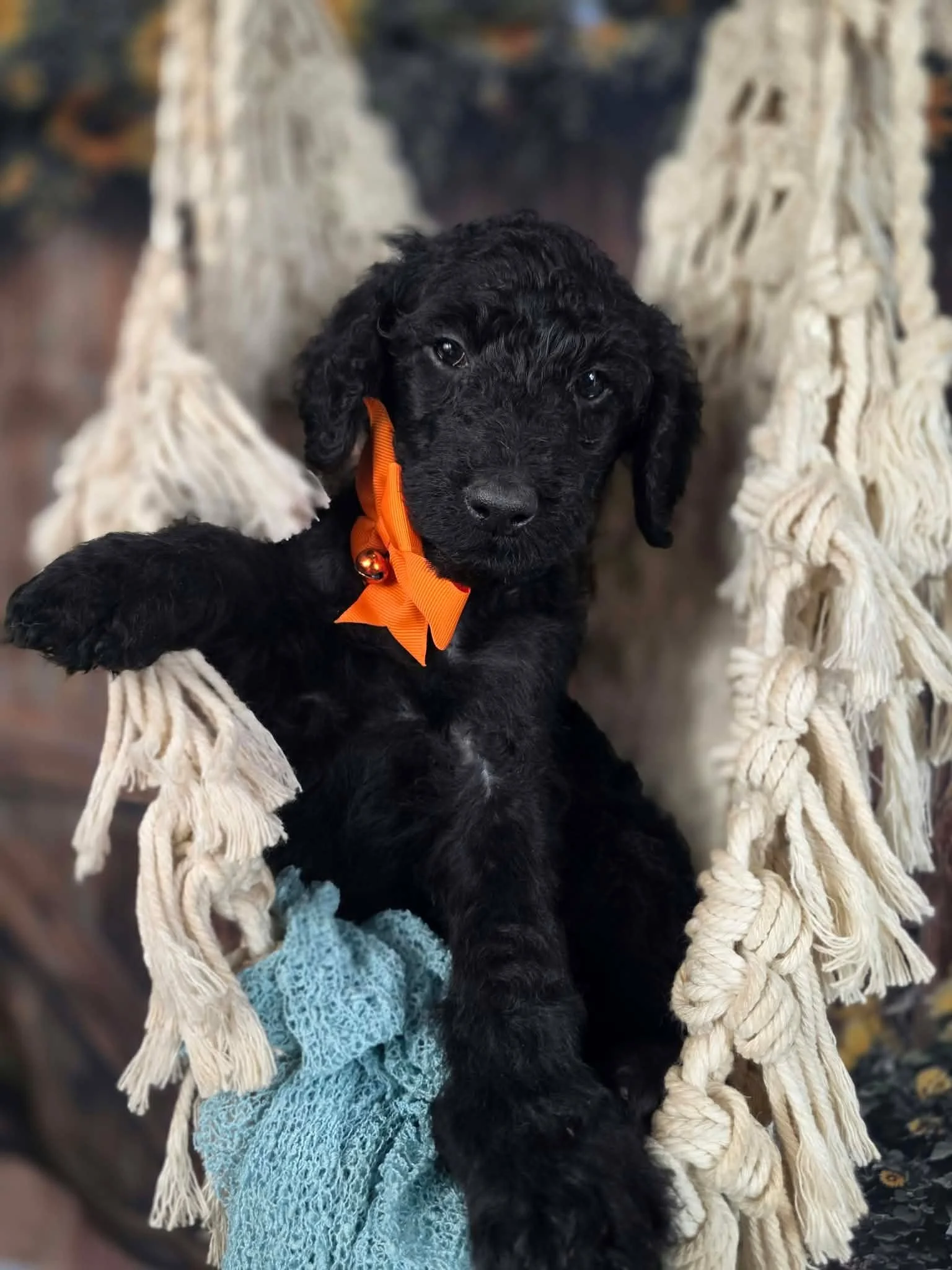
Giraffe - Best Adventure Buddy
Some puppies are ready to conquer the world all on their own. Giraffe seems to think the adventure would be a whole lot more fun if you came along!
Giraffe is our friendly, polite little gentleman who genuinely enjoys spending time with his people. He's playful, engaging, and affectionate without being particularly pushy or demanding. He doesn't need to climb all over you or constantly invade your personal space to make a connection. He's simply happy to be part of whatever you're doing!
One of Giraffe's standout qualities during his temperament evaluation was his excellent human focus. He enjoyed playing with toys, showed off some retrieving skills, and happily participated in interactive games. Interestingly, he often seemed more interested in the person playing with him than the toy itself! For Giraffe, the relationship appears to be every bit as rewarding as the activity.
And that's something I really like about this boy.
I think Giraffe could make an excellent sporting prospect with a bonded handler. He has good motivation, enjoys interaction, and seems to appreciate having someone to work alongside. Rally, obedience, or other activities that emphasize teamwork could be wonderful outlets for him. I suspect that as his relationship with his person develops, we'll see even more of what this boy is capable of.
During testing, Giraffe showed some hesitation when asked to navigate unfamiliar obstacles independently. He investigated the challenges but wasn't quite ready to tackle everything on his own. However, this is only one part of the picture. Giraffe demonstrated good overall confidence and resiliency, along with very little sensitivity to unexpected sights or sounds. Those are encouraging qualities for a puppy who may be joining his family on all sorts of adventures! His hesitation appeared more specific to tackling those particular challenges independently than a general discomfort with his environment.
It's also worth remembering that the puppies had their veterinary examinations earlier that day. By the time we began temperament testing, they'd already had a pretty big day! That can influence energy, motivation, and enthusiasm for unfamiliar activities, so we consider those circumstances alongside everything we've observed throughout their development.
Giraffe also scored a 4 in tenderheartedness, meaning he's quite responsive to the emotions and emotional energy of the people around him. Combined with his excellent human focus, this could contribute to a particularly connected relationship with his family. He's likely to be aware of the emotional atmosphere around him, making the way his people communicate and interact an important consideration.
With moderate energy and intensity, Giraffe offers an appealing balance for someone who wants a dog who enjoys participating without necessarily needing to be going full throttle all day. He's a boy who could enjoy hiking, camping, exploring new places, or learning a new sport, while also fitting beautifully into the quieter moments of everyday family life.
Because Giraffe enjoys human connection so much, I would encourage his family to continue developing his independence alongside that wonderful partnership. Giving him opportunities to solve problems on his own, enjoy independent activities, and become comfortable spending time apart from his people will help him grow into a well-rounded adult.
One other thing that makes Giraffe unique is his coat. His puppy coat is thinner and wirier than we'd typically expect in a Standard Poodle, although he does have furnishings on his face and feet. While this isn't a coat we'd select for a conformation or competitive grooming prospect, it may have some practical advantages for an outdoorsy companion. Of course, his adult coat could develop differently.
So, who is Giraffe's perfect adventure buddy?
I see Giraffe thriving with an individual, couple, or family with respectful children who genuinely enjoys including their dog in everyday life. He could be a wonderful companion for a more relaxed household that enjoys occasional adventures, or an active home interested in exploring dog sports and building a strong working partnership.
I wouldn't select him as a service prospect, but I do think he has some lovely possibilities as both a family companion and a sporting partner. His ideal person will appreciate his natural connection with people while continuing to encourage his independence and problem-solving skills.
Giraffe may not be the first puppy to charge off and conquer the wilderness on his own, but give this boy a favorite human and something fun to accomplish together, and I think they'll make a pretty fantastic team.
Because for Giraffe, the best part of an adventure isn't necessarily where you're going. It's who gets to come along.
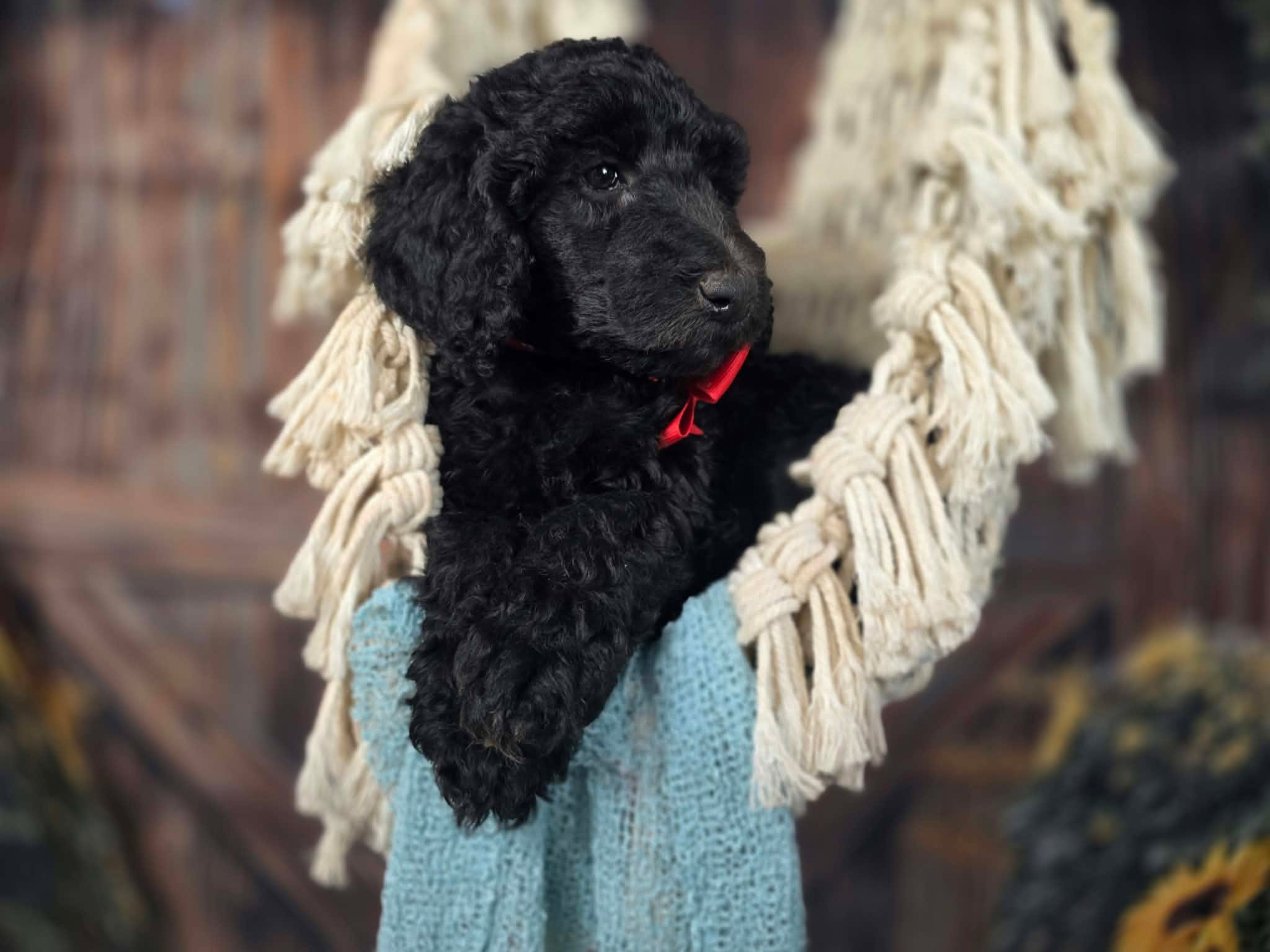
Lion - Most Likely to Make Your Day
Some puppies are determined to be the center of attention wherever they go. Lion seems perfectly happy to let the world carry on without him for a little while. Especially if he's in the middle of a really good nap!
At our Puppy Party, Lion spent much of the first part of the afternoon sound asleep inside a cubbyhole while we were all gathered indoors. Apparently, he wasn't particularly concerned about missing any of the festivities!
When Lion finally woke up, that was our cue to head outside for a potty break. And once he was outside, he was ready to play!
I think that little story tells us something important about this boy.
Lion is a confident, affectionate, playful puppy with excellent motivation and a genuine interest in people. He's enthusiastic about interacting, enjoys having something to do, and isn't particularly shy about making himself part of the action. But we've also seen that he can be perfectly content resting while life carries on around him.
That's a combination I really appreciate.
During his temperament evaluation, Lion demonstrated excellent motivation and enthusiasm for interactive play. He particularly enjoyed tugging with toys, and there were moments when playing with the person holding the toy seemed considerably more interesting than chasing it across the room.
He also climbed right into my lap during testing. No hesitation, no need for an invitation. Apparently, he'd decided that was a perfectly reasonable place to be!
Lion scored a 4 in human focus and a 4 in human assertiveness, which fits with the puppy we've been getting to know. He enjoys people, willingly initiates contact, and is comfortable engaging without needing constant reassurance or encouragement.
One of Lion's standout qualities is his excellent confidence. He scored a 5, along with good nerve strength and resiliency. During testing, he successfully navigated the wobble board with encouragement, showing a willingness to approach an unfamiliar challenge. He also demonstrated very little sensitivity to unexpected sights or sounds.
I find that combination particularly encouraging when considering Lion's potential for service or therapy work.
For a dog who may eventually accompany someone into busy public environments, confidence and environmental stability are important qualities. Lion's willingness to engage with people, excellent motivation, and ability to approach unfamiliar experiences give us a promising foundation to build upon.
His Puppy Party nap adds another interesting piece to that picture. A puppy who can rest comfortably while people and activity are happening around him, then wake up ready to participate, is showing us something worth paying attention to. It's only one observation, of course, but the ability to settle and transition between rest and activity is something we'd certainly want to continue developing in a future working dog.
Lion also scored a 4 in tenderheartedness, meaning he's quite responsive to the emotions and emotional energy of the people around him. Combined with his confidence and resiliency, I think this could be particularly valuable in a dog whose future may involve supporting or interacting with people.
And while I see excellent potential for service and therapy work, I certainly wouldn't limit Lion to those paths.
With an energy level of 4 and moderate intensity, he could be a wonderful companion for someone who enjoys training, playing, exploring new places, or simply including their dog in everyday activities. His motivation and enthusiasm also make him an appealing sporting prospect, particularly for activities that emphasize interaction and teamwork.
Lion does have his own opinions occasionally. During his evaluation, he discovered a route back toward his mother and littermates, which understandably became a little more interesting than the activities we had planned for him! His family will want to continue developing his focus around distractions and reinforcing the value of working together.
It's also worth remembering that the puppies had veterinary examinations earlier that day, and Lion's evaluation included some interruptions. We consider those circumstances alongside everything we've observed throughout his development rather than drawing sweeping conclusions from a single afternoon.
So, who is Lion's perfect person?
I can see Lion thriving with an individual, couple, or family who enjoys having a dog actively involved in their lives. He could be a particularly exciting prospect for someone interested in developing a service or therapy dog, provided they're prepared for the training, socialization, and continued evaluation that work requires.
I also think he'd be a lovely fit for a family with respectful children, an active household looking for an engaging companion, or someone interested in recreational dog sports. His ideal people will appreciate his affectionate nature, encourage his curiosity, and enjoy giving him opportunities to learn.
What I particularly like about Lion is that we're seeing more than one side of his personality. He's confident without needing to be the center of attention, enthusiastic without being frantic, and affectionate without appearing to need constant interaction.
I can picture him enjoying a busy morning with his person, participating in training or accompanying them through their daily routine, and then settling in for a well-earned nap while the rest of the world carries on.
And if that nap happens to be in a cubbyhole while there's a party going on? Well, apparently Lion has his priorities!
Lion — Most Likely to Make Your Day.
Because I suspect the best thing about life with Lion won't be any single adventure or accomplishment. It'll be all those ordinary moments when you look over at him and realize just how much you enjoy having this boy by your side.
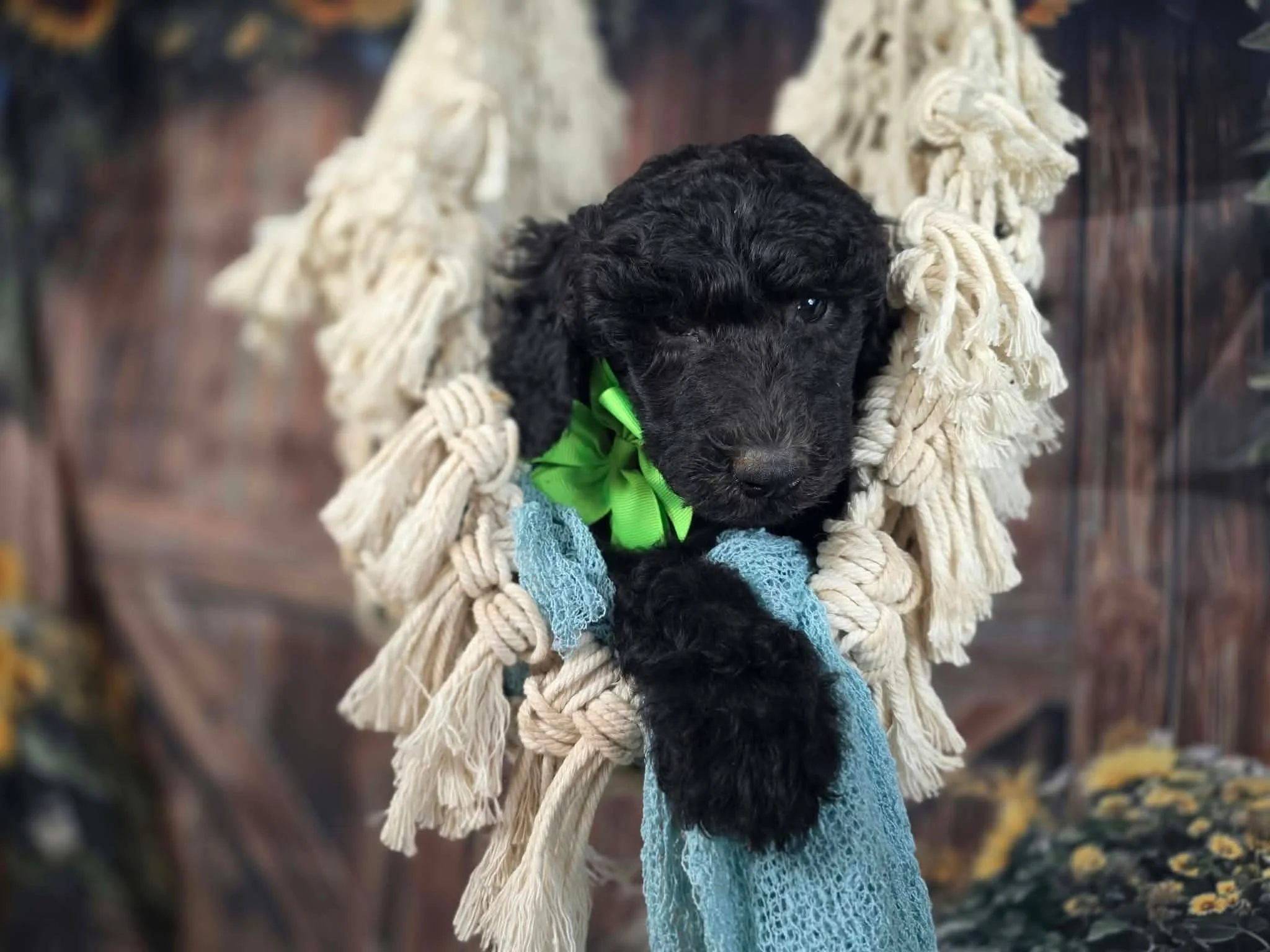
Cheetah - Most Likely to Find His Own Fun
Cheetah is a puppy who knows how to have a good time, whether anyone else wants to participate or not! He's confident, independent, entertaining, and quite happy to make his own decisions about how to spend his day. He's not particularly concerned about being the center of attention, and he certainly doesn't need an audience to enjoy himself.
We've seen that independence throughout his development. When it's time for everyone to come inside, Cheetah is frequently one of the last puppies through the dog door. Apparently, he has a few things to finish before joining the rest of us! He's perfectly comfortable exploring, playing, and finding his own entertainment without needing someone to direct every activity.
And when Cheetah finds something he enjoys, he REALLY enjoys it.
During temperament testing, he had a wonderful time with the toys, especially those he could grab and shake with enthusiasm. He also demonstrated a particular appreciation for human toes and feet. We're working on convincing him that there are far better things to put his mouth on, although he seems to think he's discovered a perfectly entertaining game!
What makes Cheetah interesting is the combination of moderate energy and high intensity. He's not a puppy who needs constant activity, but when something catches his interest, he throws himself into it wholeheartedly. There's a big difference between a dog who is always busy and one who knows how to turn up the excitement when the occasion calls for it.
Cheetah also has tremendous confidence. During testing, an animated toy startled him for a moment. He recovered immediately, investigated it, and went right back to having fun. That response tells us a great deal about how he approaches the world. He's not easily rattled, and unfamiliar sights and sounds don't tend to bother him.
I especially appreciate these qualities when thinking about Cheetah's future as a companion or working dog.
His independence is one of his greatest strengths. Not every dog needs to be attached to someone's hip to have a wonderful relationship with their person. Cheetah is comfortable occupying himself, and that's a valuable quality in a household where people have jobs, responsibilities, and lives that don't revolve around entertaining the dog every minute.
It's also an advantage worth recognizing in service, therapy, and facility work. A working dog spends a tremendous amount of time simply being present while their person goes about everyday activities. Sitting through classes, accompanying someone to appointments, or relaxing while a handler works requires a dog who is comfortable when nothing particularly exciting is happening.
Cheetah brings confidence, environmental stability, and natural self-sufficiency to that picture. His training will need to emphasize building a strong relationship, developing reliable handler engagement, and teaching him when it's time to work and when it's time to relax. Finding what genuinely motivates him will be important. He isn't a puppy who automatically considers every human suggestion a brilliant idea, but he certainly knows how to become enthusiastic when something interests him!
Handling is another area where we'll want to continue building positive experiences. During testing, Cheetah made it clear when he'd rather be doing something else, although he was willing to return to interaction afterward. He does best when people respect his communication while continuing to teach him the skills and cooperation expected of a well-mannered dog.
For everyday companionship, I love Cheetah for an individual, couple, or family who appreciates a dog with a little independence. He has the confidence for outings and adventures, the playfulness to make life entertaining, and the ability to enjoy himself when his people are occupied. Families with teenagers are an especially nice match, and younger children who understand respectful handling can enjoy him too.
Cheetah isn't trying to be everybody's shadow. He's busy enjoying life, investigating whatever catches his attention, and occasionally reminding us that toes are apparently irresistible.
He's a confident little character with his own ideas, a wonderful sense of adventure, and plenty of personality. And I think the person who appreciates those qualities is going to absolutely love sharing life with him.
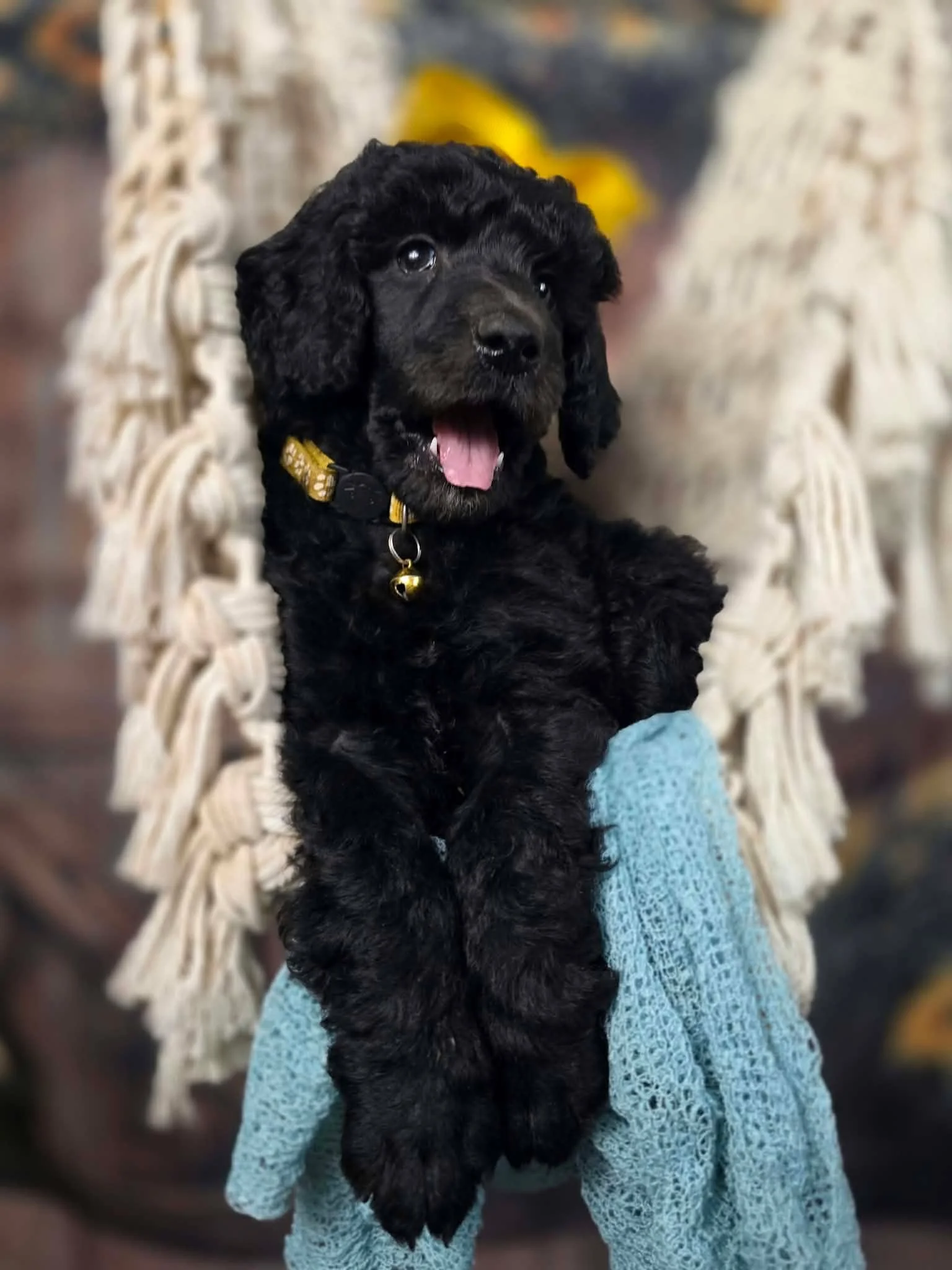
Meerkat - Most Likely to Be Full of Surprises
Meerkat is a confident, spirited little girl who has plenty of personality and isn't afraid to share it! She's playful, curious, adventurous, and perfectly capable of finding something entertaining to do without waiting for someone to suggest an activity.
She's also a puppy whose temperament evaluation requires a little more explanation than most.
Meerkat had the distinction of being our very first puppy tested that day, and the timing couldn't have been much worse. She had JUST returned home from her veterinary appointment, and apparently, she would have preferred a nap over another round of activities!
To complicate matters, Lesli was sick, so Bailey stepped in to conduct the evaluations. This was Bailey's very first time temperament testing a puppy. While we followed our testing activities, there's a learning curve to conducting an evaluation, particularly when it comes to recognizing the subtle ways puppies communicate.
And Meerkat wasn't exactly operating under ideal circumstances herself.
After her evaluation, she crawled underneath a chair and slept through the next three or four puppies' tests. That tells me something important about the puppy we were evaluating. She had already had a busy morning, and by the time we asked her to participate in testing, she was likely running on whatever enthusiasm she had left!
During her evaluation, Meerkat demonstrated tremendous confidence, enthusiasm for play, and a willingness to investigate her environment. She enjoyed the toys, became quite animated during play, and occasionally decided that ankles and feet were every bit as entertaining as the toys we'd provided. Apparently, toes are becoming a recurring theme with this litter!
She also demonstrated independence. She wasn't always particularly interested in following Bailey's suggestions, and her attention sometimes wandered toward whatever else caught her interest.
On paper, that resulted in lower motivation and human focus scores than I would have expected.
And this is where I think it's important to explain the difference between a temperament evaluation and the observations we make while raising these puppies.
I've spent weeks watching Meerkat interact with people, respond to our daily curriculum, and navigate new experiences. Based on those observations, I believe her motivation and human focus are considerably stronger than what she demonstrated during testing.
I don't believe the evaluation accurately captured those particular qualities.
That doesn't mean we disregard what happened during testing. It means we recognize that a puppy's behavior can be influenced by fatigue, unfamiliar circumstances, and the experience of the person conducting the evaluation.
Meerkat's confidence and resilience, however, were unmistakable. She's comfortable exploring, isn't easily unsettled, and approaches the world with a healthy sense of curiosity. When something surprises her, she's capable of recovering and continuing with her activities.
Those are qualities I value tremendously, particularly when considering puppies for working roles.
I actually believe Meerkat has very good potential as a service dog prospect.
Her confidence, environmental stability, and ability to function independently are valuable foundations. Service dogs need to navigate busy environments, encounter unexpected situations, and remain comfortable in circumstances where their handlers may not always be able to provide reassurance or direction.
Meerkat's lower tenderheartedness is also worth understanding correctly. It doesn't mean she lacks affection or the ability to form a strong relationship with her person. It means she isn't particularly inclined to absorb the emotions happening around her.
For certain types of service work, that can be a significant advantage.
A dog who remains emotionally steady when their handler is anxious, frustrated, or overwhelmed may be better equipped to continue performing trained tasks without becoming distressed themselves. The goal isn't necessarily a dog who feels everything their person feels. Sometimes, the most valuable partner is the one who can remain grounded when the world around them isn't.
Of course, service work requires more than confidence. Continued development of handler engagement, reliable responses, impulse control, and task-specific skills will be essential. As with any puppy, her ultimate suitability will depend on how she matures and what work is expected of her.
For companionship, Meerkat has a great deal to offer as well.
She's an excellent candidate for an active individual, couple, or family who enjoys getting out and doing things together. Hiking, exploring, training, and other adventures could be wonderful outlets for her curiosity and enthusiasm. I particularly like her for families with teenagers who would enjoy an interactive, playful dog.
Younger children can certainly be part of her world too, although her enthusiastic play and occasional interest in ankles mean that teaching appropriate interactions and managing excitement will be important.
I also wouldn't automatically rule out a quieter household. What matters is whether her people are willing to provide the activity, enrichment, and training she needs—not whether their home is constantly bustling.
And there's one more thing I think is worth remembering about Meerkat.
After all that enthusiasm during testing, she found herself a quiet spot under a chair and went to sleep.
For the next several evaluations, while other puppies were playing, exploring, and generally creating the usual puppy chaos, Meerkat was perfectly content to rest.
I think that moment is every bit as important as the activity we observed during her test. It reminds us that even a confident, enthusiastic puppy can recognize when she's had enough and settle down.
Meerkat is a bright, confident little girl with an adventurous spirit, a playful personality, and a great deal of potential. Her evaluation gave us useful information, but it didn't tell her entire story.
And having watched this girl grow and develop, I believe there's considerably more to Meerkat than what we saw during those few minutes of testing.
I'm excited to see what she accomplishes with someone who recognizes all the wonderful possibilities she has to offer.
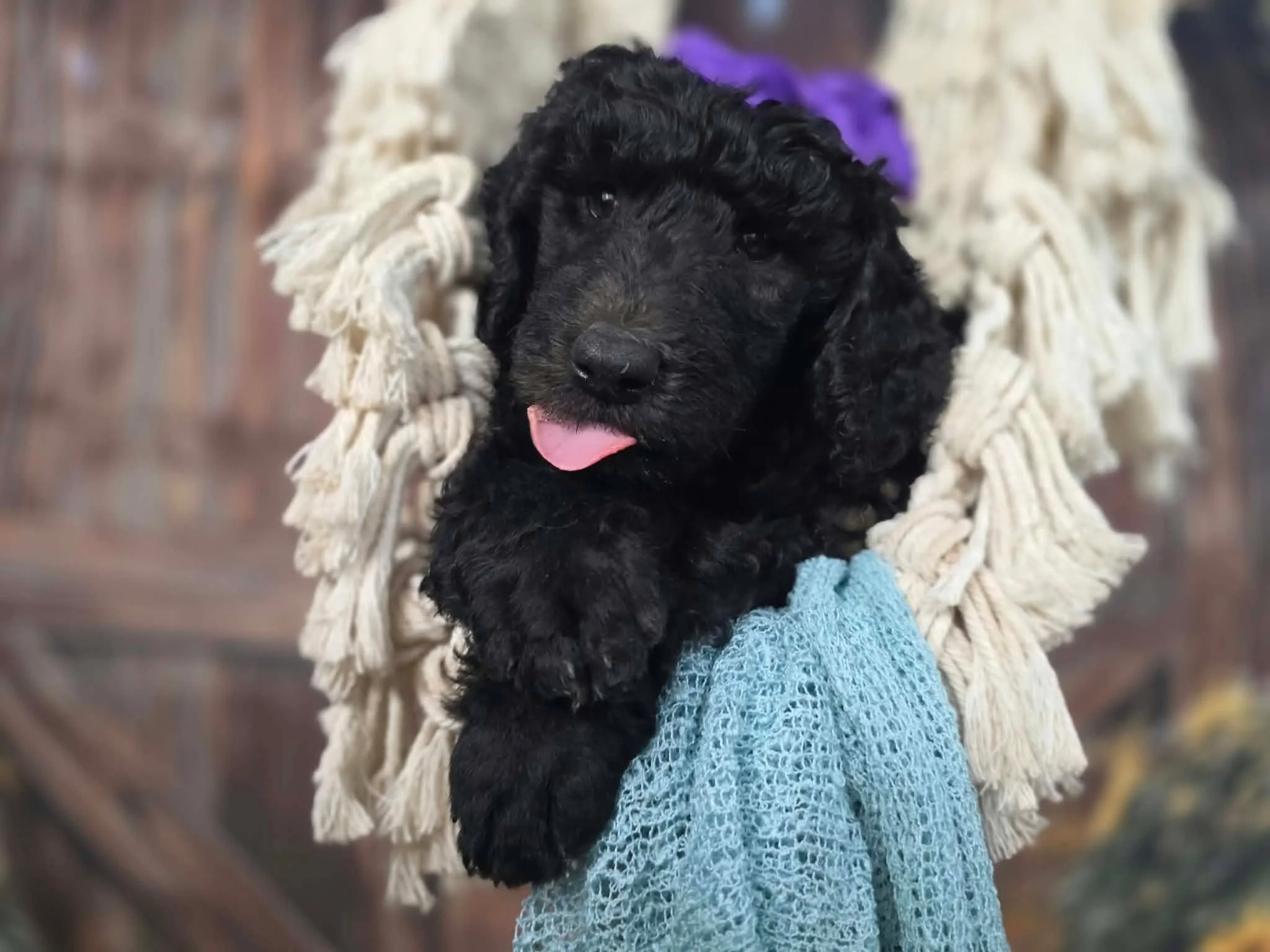
Hippo - Most Likely To Be Everyone’s Cup of Tea
Hippo is one of those puppies who makes it remarkably easy to appreciate what a well-rounded temperament looks like. She's confident, playful, affectionate, independent, and just assertive enough to make sure she doesn't get overlooked. She enjoys being part of the action, but she doesn't need to be the center of it. And perhaps one of my favorite things about Hippo is that she seems to have figured out how to ask for what she wants without making a production out of it!
Throughout her development, Hippo has been one of our more polite puppies. She's frequently offered a sit when she wants attention, something we've been working on with the entire litter through manding. Rather than throwing herself at us or demanding that we acknowledge her, Hippo has learned that sitting politely is a pretty effective way to get what she wants. I appreciate that about her, especially because she's not a timid or particularly reserved puppy. She's quite confident! She just doesn't seem to believe that everything requires a dramatic entrance.
During temperament testing, Hippo was actually the first puppy to approach the evaluator on her own. She was comfortable in the environment, interested in interacting, and happy to investigate what was available. She enjoyed playing with the toys, even retrieving one and bringing it back when asked. She was willing to share the game with her person, but she was also perfectly content entertaining herself when something else caught her interest.
That balance between human engagement and independence is one of Hippo's greatest strengths.
She has excellent human focus, but that doesn't mean she needs someone directing her every move. She enjoys being with people and participating in activities, yet she's comfortable exploring and finding her own entertainment. During testing, she eventually realized she'd lost track of her evaluator and went looking for them. I thought that was a particularly nice example of her personality. She doesn't need to be attached to someone's hip to maintain a connection with them.
I can picture Hippo being the kind of dog who happily accompanies her family on an adventure, enjoys whatever activities they've planned, and then settles into her own business when everyone gets home. She doesn't appear to need constant reassurance or entertainment, which can be a wonderful quality in a family companion.
Hippo also demonstrated excellent environmental confidence. When introduced to the unfamiliar umbrella, she was willing to approach and investigate it. By the end of that exercise, we'd declared that she'd conquered the umbrella! She also participated in other challenges, including the slide, showing a willingness to try new things and work through unfamiliar situations.
Her sound and sight sensitivity were both very low, and she demonstrated good resilience when something wasn't entirely to her liking. Those qualities, combined with her confidence and motivation, give her a promising foundation for a wide variety of activities.
One of the more interesting moments during Hippo's evaluation came during the handling portion. She allowed the evaluator to hold her, rub her belly, and handle her tail, but she wasn't particularly enthusiastic about every part of the experience. At one point, she slowly raised her paw, almost as though she were politely asking, Excuse me, could we be finished with this now?
I thought that was rather endearing.
Hippo wasn't thrilled, but she tolerated the handling and communicated her discomfort without making an enormous fuss. When she was put down, she needed a little time before returning to play. That's useful information for her future family. She's a puppy who deserves to have her communication respected, and we'll want to continue building positive associations with grooming and handling. The goal isn't simply to have a dog who tolerates things she dislikes, but one who learns to feel comfortable and confident with them.
It's also worth remembering that Hippo had a very full morning before temperament testing. The puppies had their veterinary examinations, and Hippo had also participated in a field trip. She was tired! While that doesn't invalidate what we observed, I do think it's important to consider when looking at her enthusiasm and responses during individual activities.
Another quality I appreciate about Hippo is her responsiveness to human emotions. During the portion of testing where the evaluator pretended to be upset, Hippo appeared to notice and care about what was happening. Once the interaction ended, however, she was able to move on and investigate something else. That ability to recognize emotional changes without necessarily remaining preoccupied with them is worth watching as she matures.
When I look at Hippo's overall temperament, I see a puppy with an unusually broad range of possibilities.
She has the confidence, resilience, motivation, and human engagement that could serve her well in performance sports, therapy work, service training, or classroom and facility environments. Her independence may actually be an advantage in certain working roles, particularly those requiring a dog to remain comfortable and capable without constant direction. Of course, specialized work will depend on her continued development, training, and the specific expectations of the role, but I certainly wouldn't want to overlook her potential.
And as a family companion? I think Hippo could be wonderful in a tremendous variety of households.
She has enough energy to enjoy an active family, adventures, outings, and training activities, but she isn't an especially intense puppy. She could be equally happy with a family whose adventures are a little more modest, provided she's given appropriate opportunities for exercise, enrichment, and engagement. Her polite approach to people and willingness to participate make her an appealing candidate for families with respectful children, couples, or individuals.
I don't think Hippo needs a particularly specialized home. I think she needs people who appreciate a confident, capable, engaging dog and are willing to continue developing all those wonderful qualities.
Some puppies have very specific personalities that make it easy to identify exactly what kind of family will appreciate them most. Hippo is a little different. Her strengths aren't concentrated in one particular area. They're spread across so many aspects of her temperament that I can imagine her succeeding in a remarkable variety of situations.
Hippo is the kind of dog you can do just about anything with, but you don't have to do everything with.
And that's why I think our little Hippo might just be Most Likely to Be Everyone's Cup of Tea.
Not because every family is the right family for every puppy, but because Hippo has so many wonderful qualities to offer the people lucky enough to call her theirs.
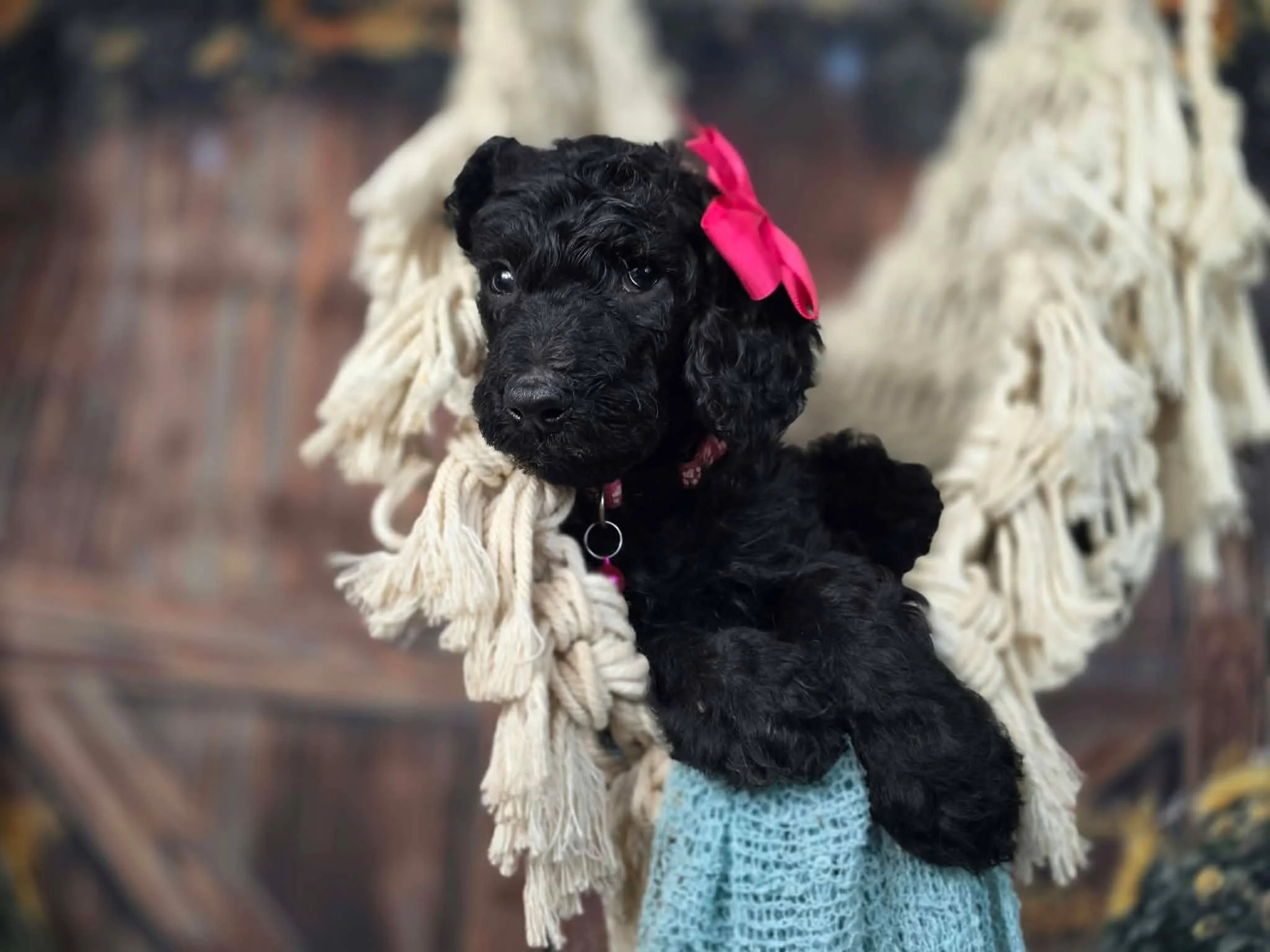
Flamingo - Most Likely to Know the Magic Word
If there's one puppy in this litter who has figured out how to work the system, it's Flamingo!
Flamingo is a confident, affectionate, enthusiastic little girl who has discovered that good things happen when you pay attention to your people. And she's particularly interested in making sure she doesn't miss any of those good things!
Of all nine puppies, Flamingo is hands down our best mander. Manding is something we teach our puppies to encourage polite behavior when asking for attention, and Flamingo has embraced the concept wholeheartedly.
The moment she hears me say "Yes!" it's as though a little lightbulb goes off in her head. "OOOOHHH! We're doing this!" And here she comes, ready to present herself for whatever wonderful attention might be available.
It's absolutely delightful to watch, but it also tells us something important about Flamingo. She's paying attention. She's making connections. She's learning how her behavior influences the world around her, and she's putting that information to work!
That quick mind is one of Flamingo's defining characteristics. She's an enthusiastic learner with excellent human focus and plenty of motivation, whether we're talking about toys, food, or simply interacting with her people.
During temperament testing, Flamingo showed wonderful interest in toys and interactive play. She happily participated in retrieving games and demonstrated that she's quite willing to work with someone when the activity is rewarding. When following the evaluator wasn't particularly interesting on its own, adding a toy changed her perspective considerably!
I appreciate puppies who show us what motivates them. Flamingo makes it pretty easy to figure out how to get her interested in learning something new.
She's also a confident, resilient little girl. She approaches new experiences with a good attitude, and when something requires a little encouragement, she's generally willing to give it a try. Her low sensitivity to sights and sounds is another positive quality that should serve her well as she continues experiencing the world.
One of the things I particularly appreciate about Flamingo is that her strong human focus doesn't come at the expense of her independence.
She genuinely enjoys people. She wants to interact, participate, and be included. But she's also perfectly capable of entertaining herself and doesn't need someone constantly directing her activities. She has a nice off switch, too, which is something I value tremendously in a companion.
Flamingo isn't without her opinions, of course!
During the handling portion of temperament testing, she cooperated with the evaluator but wasn't particularly enthusiastic about every part of the experience. She communicated that she'd had enough by looking away and attempting to create a little distance. Once given some space, she was perfectly happy to return to playing.
I consider that useful communication rather than a character flaw. There's a difference between a puppy who tolerates something and one who enjoys it, and we'll continue building her comfort with handling as she matures.
She also has a mischievous, mouthy side when she's excited. Fingers, clothing, and occasionally faces can become part of the game if she gets carried away. That's something we're actively working on, and her enthusiasm for learning should be a real asset as her future family continues teaching appropriate manners.
Flamingo is one of those puppies I can envision being happy in quite a variety of homes. An active family, an individual interested in training or performance sports, or a somewhat more relaxed household that enjoys including their dog in everyday life could all be wonderful possibilities.
Her confidence, motivation, resilience, and responsiveness also give her potential for more structured activities. As always, suitability for specialized work would depend on the particular expectations and her continued development.
One physical consideration worth mentioning is her coat. Flamingo's puppy coat is somewhat stringy, although not nearly as pronounced as Cheetah's or Zebra's. It's simply something I want prospective families to know, particularly if coat quality is an important consideration.
What I find so appealing about Flamingo is how naturally her different qualities fit together. She's affectionate without being needy, confident without being overwhelming, playful without needing constant entertainment, and attentive without losing her independence.
Flamingo has figured out that listening to her people opens the door to wonderful things. And judging by how quickly she comes running when she hears "Yes!", she has absolutely no intention of missing an opportunity!
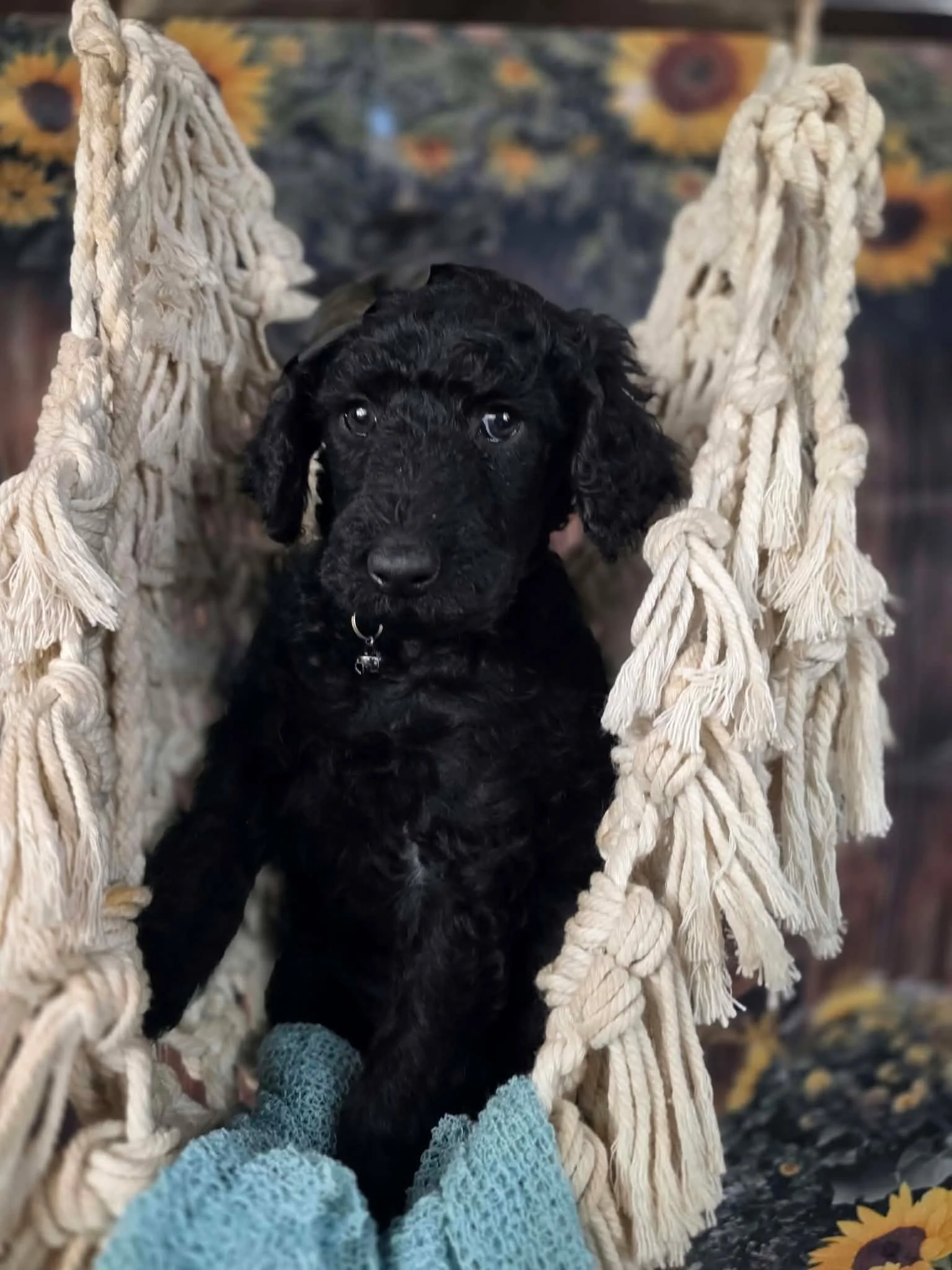
Zebra - Most Likely to Say “Again!”
I have to tell you, Zebra might be one of the funniest puppies I've ever temperament tested when it comes to handling.
Now, we've spent the last seven weeks teaching these puppies that being handled is just part of life. We touch their feet, look in their mouths, mess with their ears, and do all sorts of things that puppies don't necessarily appreciate. Most of them learn to tolerate it pretty well.
And then there's Zebra.
Zebra was the only puppy in this entire litter who earned a true 5 for touch tolerance. Not because she quietly accepted everything I did, but because she genuinely seemed to enjoy it. I could be downright rude with my handling, and her response was basically, "Oh, we're doing that? Okay! Do it again!"
I don't think she got the memo that she was supposed to find any of that annoying.
What's interesting about Zebra is that she's very people-focused, but she's also quite independent. Those two things aren't mutually exclusive, and she's a really good example of that. She enjoys interacting with us, she pays attention to people, and she's perfectly happy to be involved in whatever we're doing. But she's also just as happy to find a toy, play with some crinkle paper, or entertain herself for a while.
She doesn't need someone constantly directing her activities.
Now, does that mean she's always going to do what you ask her to do? Absolutely not!
Zebra has some opinions about how she'd like to spend her time. During temperament testing, she was perfectly willing to participate when she thought something was interesting. When she didn't? Well, she wasn't particularly concerned about convincing me otherwise.
After about twelve minutes, I think she decided she'd given me enough of her time and had other things she'd rather be doing.
And honestly, that's something I think will look a little different once she's in a home with her own person.
These puppies have spent their entire lives as part of a group. They haven't had the opportunity to develop that dedicated, one-on-one relationship with someone who is consistently training them, rewarding them, and building that partnership. I think Zebra's motivation has plenty of room to grow as that relationship develops.
I actually think she has some nice potential for service work with the right person and the right tasks. Her human focus is excellent, she's generally confident, she recovers well, and that exceptional handling tolerance could be a real asset. Of course, she still has to learn that working with her person is worthwhile even when she has something else in mind!
She did have a couple of moments during testing when she wasn't quite sure about something. She didn't appreciate a toy rolling directly toward her, and she had some reservations about getting up onto an elevated seat. I don't want to pretend those things didn't happen, but I also wouldn't let a couple of moments during one testing session outweigh everything we've seen from her over the last seven weeks.
Now, here's the part I really want her future family to understand.
Zebra is a Do Not Reward the Crazy puppy.
And I mean that!
She's got plenty of enthusiasm, and if you teach her that acting like a complete lunatic gets her what she wants, she's going to be more than happy to keep doing it.
This is a puppy who needs firm, consistent boundaries. She needs to know what the rules are, and she needs those rules to stay the same tomorrow. That doesn't mean being harsh with her. It means rewarding the behaviors you actually want and not accidentally teaching her that getting increasingly wound up is the best way to get your attention.
I think Zebra is going to be a lot of fun for someone who appreciates a puppy with a little independence, enjoys training, and understands the importance of teaching an off switch.
And if you happen to be someone who enjoys grooming, brushing, handling feet, or generally fussing over your dog?
Well, Zebra might just think she's hit the jackpot.
Because while she may have some opinions about what else she'd like to do with her day, when it comes to all that hands-on attention, I suspect her answer is going to be the same.
"Again! We're doing that again, right?"
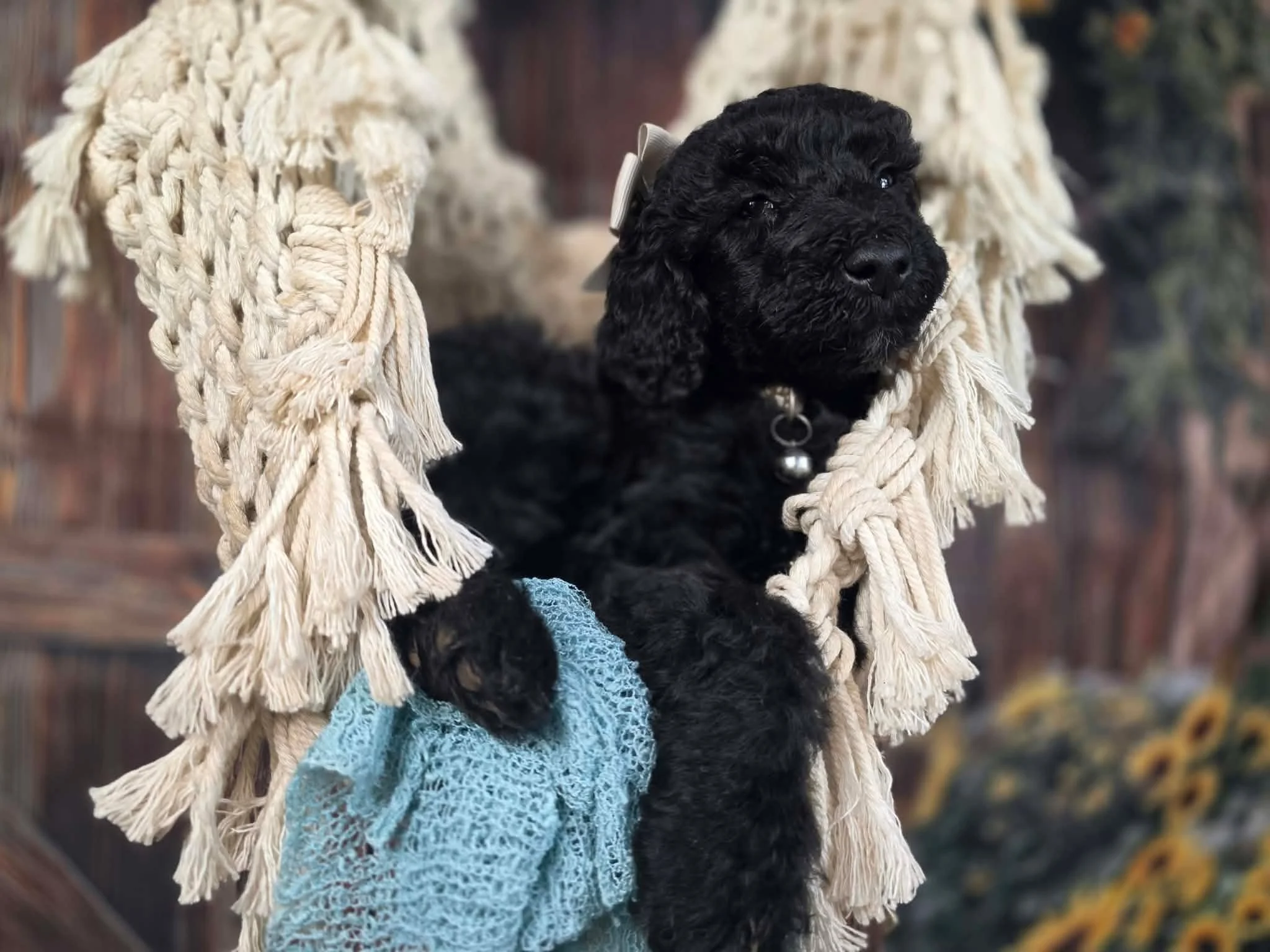
Elephant - Most Likely to Be the Quiet One in a Loud Room
In a litter full of BIG personalities, Elephant is one of our quieter, softer little girls. She's not the puppy who needs to be the center of attention, and she's certainly not the one demanding that everybody stop what they're doing and pay attention to her.
And believe me, with some of the personalities in this litter, there's plenty of competition for that particular job!
Elephant has a more understated way about her. She enjoys playing, exploring, and spending time with people, but she doesn't make nearly as much fuss about any of it. She's simply not as demanding as some of her siblings.
I think that's one of the things that makes her special.
During temperament testing, Elephant was our second puppy of the day. The puppies had just returned from their veterinary appointments, so she was still tired when it was her turn. Bailey, who conducted her evaluation, was also someone unfamiliar to her.
Now, Elephant wasn't particularly interested in everything Bailey had planned.
She participated in some activities, investigated toys, and eventually got into playing with the ball and puffer fish. She even retrieved the ball, although apparently bringing it all the way back was an entirely separate request!
But there were also moments when she wasn't especially interested in participating. When Bailey encouraged her to follow, Elephant sometimes stayed where she was and whined instead.
And at one point, she came over and sat on my foot.
I don't think that was Elephant announcing that she'd found the perfect place to hang out. I think that was her saying, "I'm not really enjoying this, but I know you. Can you please rescue me?"
That's a very different interaction, and it fits with the softer personality we've seen from her throughout her development.
Elephant isn't a puppy who bulldozes her way through every situation. She takes things in, makes her decisions, and sometimes appreciates a little reassurance from someone familiar.
That doesn't mean she's incapable of doing things for herself. She enjoys exploring, has a genuine interest in chasing moving toys, and is perfectly capable of entertaining herself. She simply doesn't approach everything with the same enthusiasm or intensity as some of her more exuberant siblings.
Handling was another activity she wasn't particularly enthusiastic about. She cooperated, but being held and restrained wasn't her favorite thing. Once she was back on the ground and had a little time to herself, she was able to return to interacting.
For her future family, I think the important thing will be continuing to build her confidence while respecting that she has a softer personality. That means encouraging her to try new things, celebrating her successes, and not immediately rescuing her from every situation she finds uncomfortable.
And yes, it also means continuing her grooming and handling education. She's a Standard Poodle, so those things aren't optional!
I see Elephant fitting especially well with an individual, couple, or family who appreciates a dog with a quieter presence. She's playful and enjoys activities, but she isn't constantly demanding that somebody entertain her. She'll enjoy being included in everyday life, having opportunities to explore, and developing a relationship with people who understand her.
I would be a little more selective about homes with very young, busy children. Not because she's demonstrated any concerning behavior, but because I think she'd appreciate a family that recognizes when she's had enough and gives her some breathing room.
Elephant has very little sensitivity to sounds or visual distractions, which is a nice quality. Her confidence and resilience are areas we'll want her family to continue developing, especially as she encounters new people and environments.
What I don't want is for anyone to mistake her quieter personality for a lack of personality.
She's got plenty of it. She just doesn't feel the need to announce herself quite as loudly as everybody else.
And in a room full of puppies competing to be the biggest character, there's something pretty wonderful about the little girl who doesn't feel the need to compete.
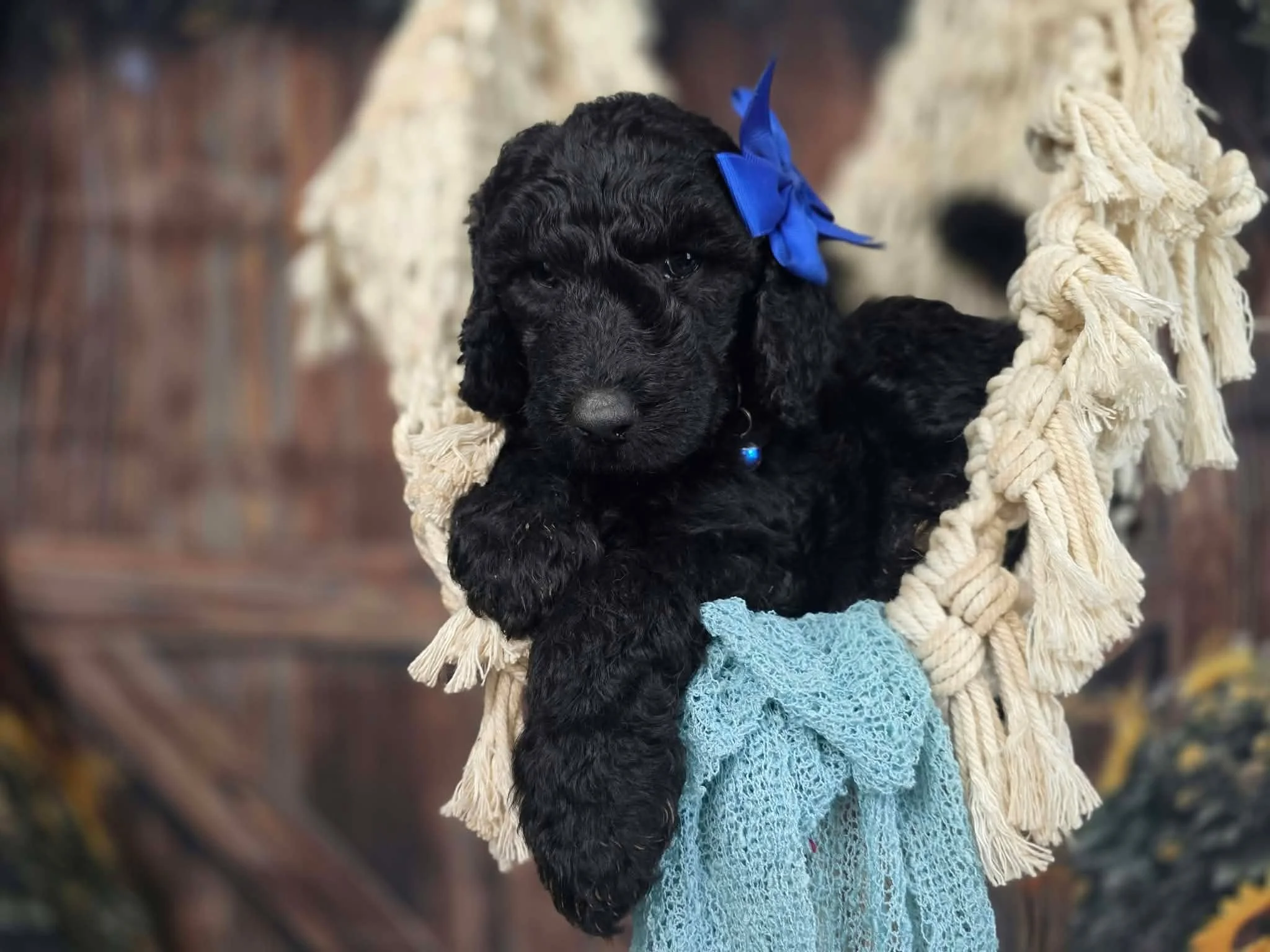
Rhino - Most Likely to Give 110%
Rhino is a girl who doesn't believe in doing anything halfway. If we're going to play, we're going to PLAY. If there's something fun happening, she'd very much like to be involved. And if there's an opportunity to turn something into a game, well, she's probably going to take it!
She's a confident, enthusiastic little girl who genuinely enjoys interacting with people. She's got plenty of personality, she's highly motivated, and she's not afraid to put herself out there. I think she's going to be a really fun dog for someone who enjoys doing things with their dog.
Now, looking at her temperament scores, you might see all those fives for energy, intensity, motivation, and prey drive and think you're getting a puppy who's going to be bouncing off the walls from morning until night.
That's really not what I've seen from Rhino.
Yes, she's energetic, and when she's engaged in something she enjoys, she puts a lot into it. But she also has a pretty decent off switch. I haven't noticed her getting ridiculously spun up or having those crazy moments where she just can't seem to settle herself. There's a difference between a puppy who has a lot to give and a puppy who doesn't know when to quit, and I think Rhino falls into that first category.
During temperament testing, she was certainly happy to show us what she's got! She enjoyed the toys, was enthusiastic about playing, and occasionally decided that ankles and feet were perfectly acceptable alternatives to actual dog toys. We're still having discussions about that particular choice!
She didn't always bring toys back, and sometimes we had to encourage her a little more to follow along. But I don't see that as a lack of interest in people. Rhino has excellent human focus. She just doesn't necessarily think every suggestion we make is the most exciting option available at that particular moment.
One thing I really like about Rhino is how confident she is. She's not a puppy who seems easily rattled, and she recovers well when something isn't necessarily her favorite activity.
During handling, we covered her eyes, checked her mouth, and touched different parts of her body. She tolerated those things and was perfectly willing to go right back to playing afterward. That doesn't mean she loved every second of it, but she handled herself well.
When she met another dog during testing, she walked over, gave a few kisses, and moved along. Nothing particularly dramatic, which is exactly what I like to see.
We also got a little insight into her tenderheartedness. When I genuinely screamed after being bitten, Rhino came over to see what was going on. Later, when we pretended to be upset, she wasn't particularly impressed. So while she certainly notices her people, I wouldn't describe her as a puppy who's especially concerned about everyone's feelings all the time.
And that's okay! Not every dog needs to be an emotional sponge.
I actually think Rhino has some really nice qualities for someone interested in service or therapy work. She's confident, resilient, motivated, people-oriented, and has the ability to settle. Obviously, there's a lot more that goes into developing a working dog, but I wouldn't hesitate to consider her as a prospect.
I also think she'd be fantastic for someone interested in dog sports, hiking, training, or simply having a dog who enjoys being included in everyday life. She could do well in a family with respectful children, too, particularly one that's willing to put some time into teaching her appropriate ways to express all that enthusiasm.
Rhino isn't a puppy I'd choose for someone who wants a dog that requires very little interaction or involvement. She's got too much potential to spend her life without opportunities to use it.
But I also wouldn't tell someone they need to be running marathons to keep her happy. I think she's going to appreciate having things to do and people who enjoy doing them with her, followed by the opportunity to relax and just be part of the family.
Rhino is going to give you 110% when it's time to do something fun. And when the fun is over? I think she'll be perfectly happy to pull up a spot beside you and call it a day.
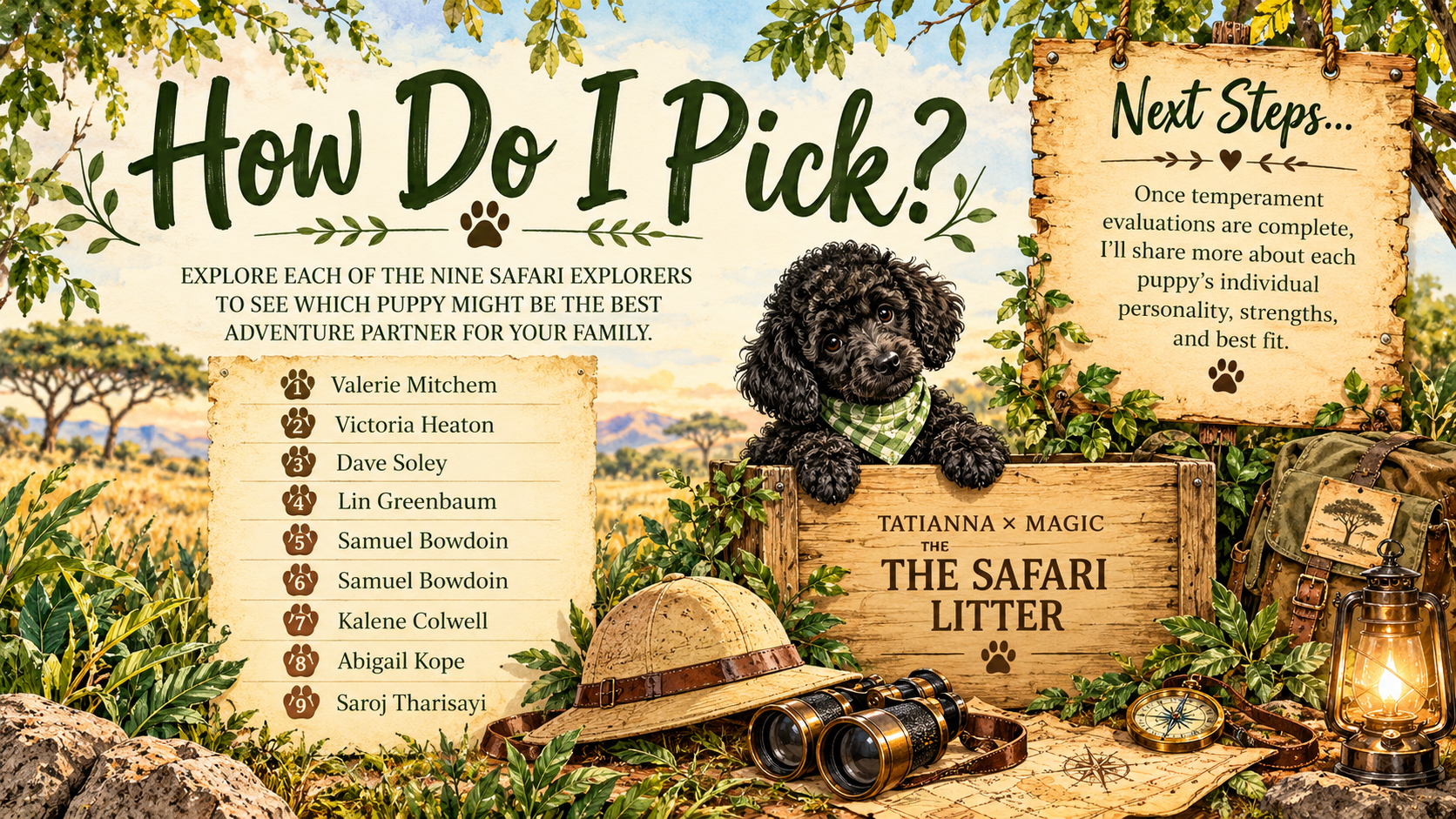
Learn how puppy selections work for Tatianna × Magic's Safari Litter, explore our reservation order, and find out what to expect as each of our nine little explorers prepares for their next great adventure.
How Do I Pick My Puppy?
We've explored the field notes, studied the temperament evaluations, and gotten to know our nine little adventurers. Now comes the exciting part—choosing which explorer will be joining your family!
Puppy selections are made in the order reservations were received and commitments to the litter were established.
Our Safari Litter selection order is as follows:
Valaurah Farms — Valerie Mitchem
Victoria Heaton
Dave Soley
Lin Greenbaum
Samuel Bowdoin
Samuel Bowdoin
Kalene Colwell
Abigail Kope
Saroj Tharisayi
How the Selection Process Works
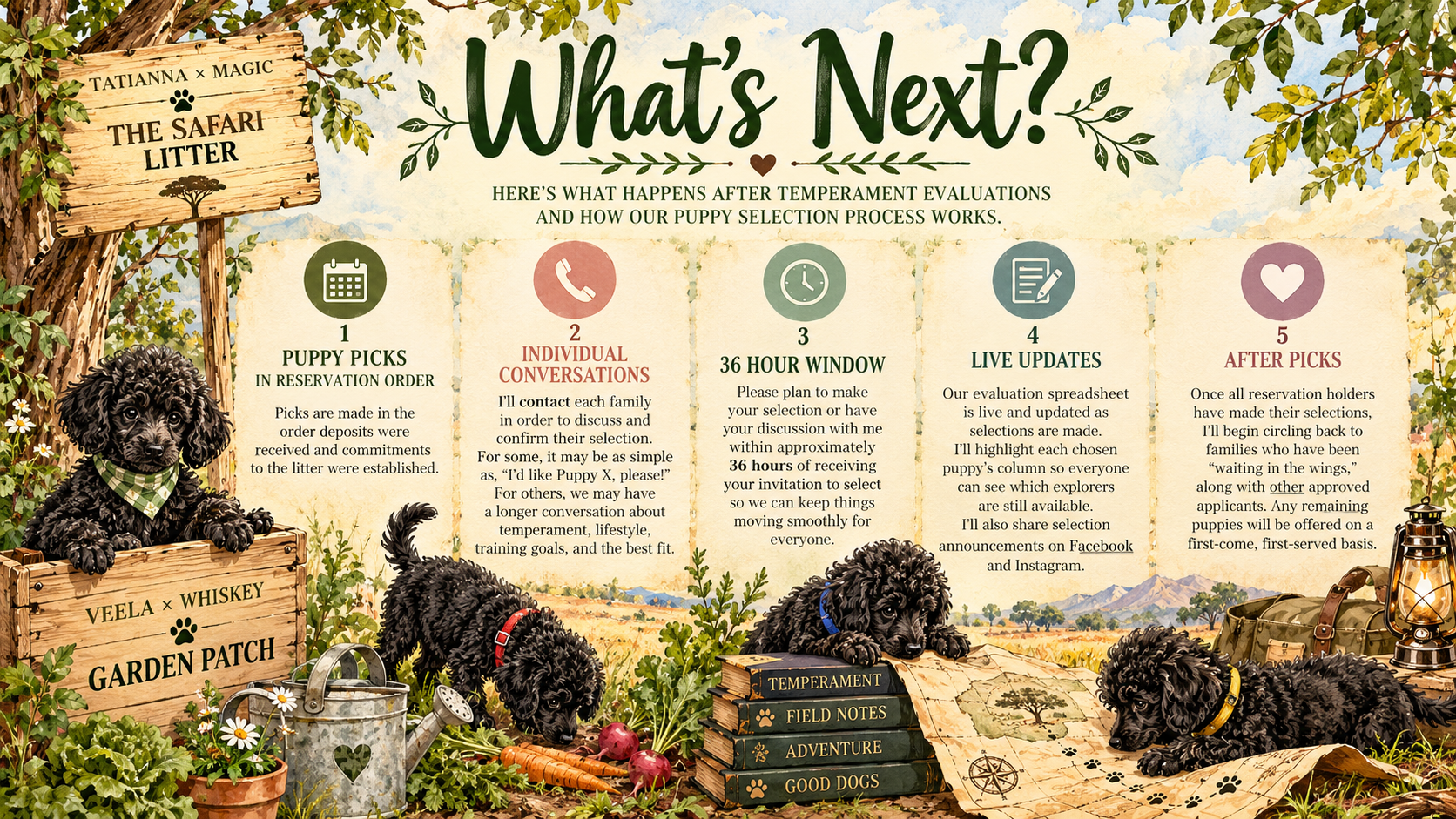
I'll be contacting families individually, in reservation order, to discuss and confirm their selections.
For some families, the decision may be as simple as:
"I'd like Puppy X, please!"
For others, we may need a longer conversation about temperament, lifestyle, training goals, and which puppy is most likely to be the right adventure partner.
Either way, I'm happy to help you navigate the decision!
Please plan to make your selection or have your discussion with me within approximately 36 hours of receiving your invitation to select, so we can keep things moving smoothly for the families waiting behind you.
Following Along on the Safari
Our master temperament evaluation spreadsheet is live, and I'll update it as families make their selections.
As each puppy is chosen, I'll highlight that puppy's column to indicate they're no longer available. This allows everyone to follow along and see which explorers are still waiting for their next adventure.
I'll also share puppy selection announcements and updates on the Valaurah Farms Facebook and Instagram pages as families make their choices.
What Happens After Puppy Picks?
Once all reservation holders have completed their selections, I'll begin circling back to families who have been waiting in the wings, along with other approved applicants who may be a good match for any remaining puppies.
Any puppies still available after the reservation process will be offered on a first-come, first-served basis, with temperament and overall compatibility remaining important considerations.
Every great adventure starts with finding the right companion. I can't wait to see where each of our nine little explorers' journeys will lead!
Learn what happens after puppy selections are complete for Tatianna × Magic's Safari Litter, including go-home scheduling, transportation arrangements, and preparing to welcome your new Standard Poodle puppy.
What's Next? The Adventure Home!
Once our nine little explorers have been matched with their families, it's time to start planning their next big adventure—GO-HOME DAY!
Our Safari puppies will be ready to head home beginning November 9th!
I'll be reaching out to each family to coordinate pickup and transportation arrangements. Whenever possible, I like to combine trips when multiple puppies are heading in the same direction, so we'll work together to find a schedule that makes sense for everyone.
In the meantime, now is the perfect time to start getting everything ready for your new adventure companion!
Be sure to check out our Puppy Survival Guide. It's packed with information to help you prepare for those exciting first days and weeks together.
Our safari at Valaurah Farms may be coming to an end, but your greatest adventures together are just beginning!