There's something magical about a night at the county fair. The glow of the midway lights, the smell of kettle corn drifting through the air, the music playing in the distance, and that feeling that something wonderful might be waiting just around the corner.
Seven weeks ago, five little puppies arrived and began their own adventure. Kettle, Ferris, Lantern, Midway, and Carousel have spent their first weeks discovering the world, making friends, finding trouble, and developing personalities that are every bit as individual as their names.
Born just three days after Tatianna's Safari litter, these puppies have grown up right alongside their nine slightly older friends. They've shared nearly every adventure, every new experience, and every step of our puppy curriculum. From their earliest sensory experiences to navigating obstacles, solving problems, exploring new environments, and learning how to interact with people, they've been part of one big, busy puppy family.
And while they've shared the same experiences, they've each taken something a little different away from them. Some are first in line when there's something new to investigate. Others prefer to watch the excitement unfold before deciding whether to join in. Some are natural entertainers, some are thoughtful observers, and some seem to believe the entire slide was built specifically for their amusement!
That's what makes this stage so exciting.
Over the past seven weeks, we've watched their personalities begin to emerge through everyday interactions, structured curriculum activities, and countless little moments that tell us who these puppies are becoming. Now, with temperament testing complete, it's time to bring all those observations together and help each family find the puppy who will be the best fit for their lives.
Because as wonderful as those first sparks of puppy love can be, we're not simply looking for the puppy who catches your eye. We're looking for the one who will still be your perfect companion long after the midway lights go dark.
So grab your ticket, take one more stroll down the midway, and get ready to meet the five little personalities who have made this county fair unforgettable.
It's time to pick your puppy! 🎟️
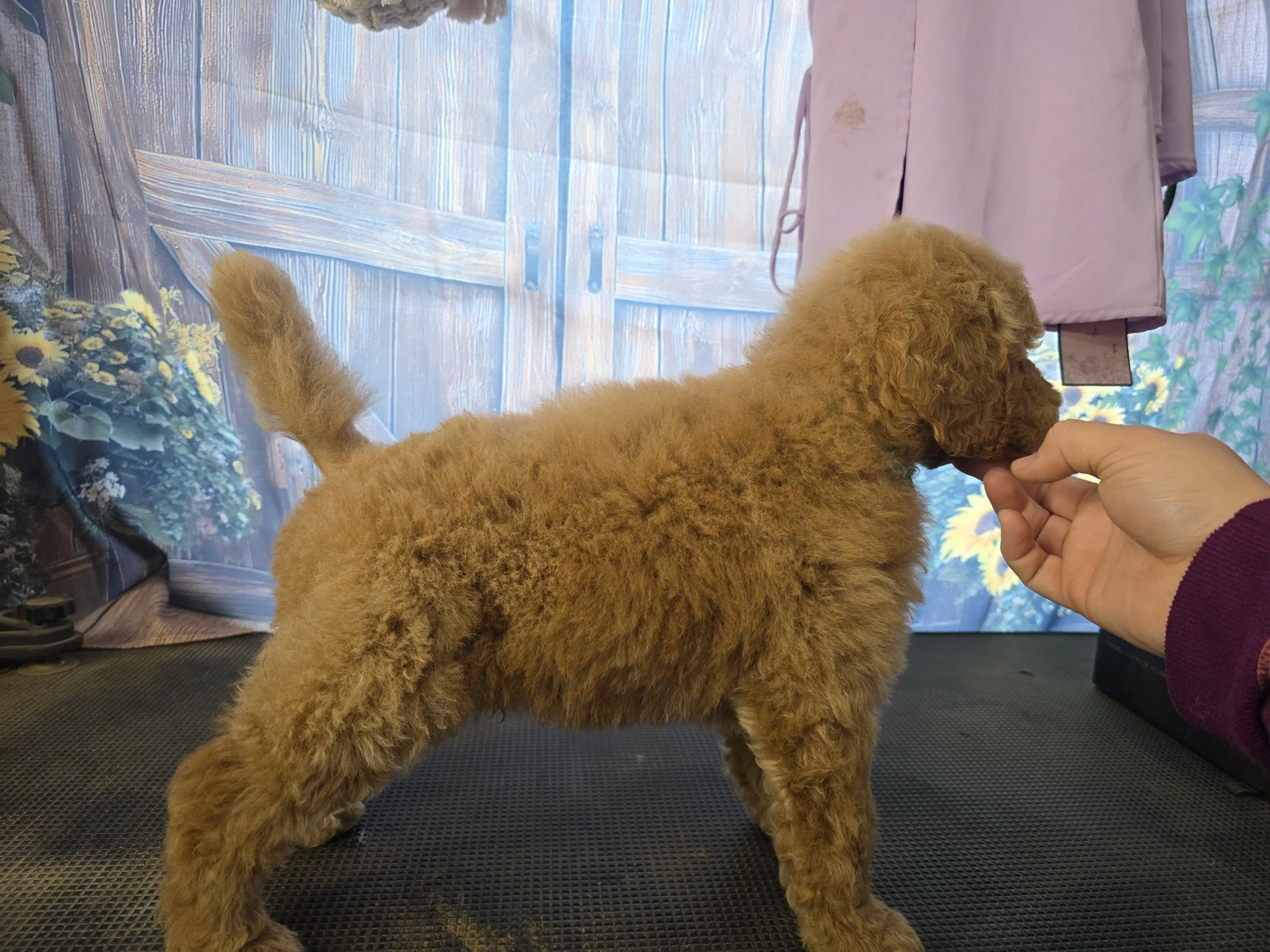
Your Ticket to Forever: Pick Your Puppy!
You've spent the past seven weeks following our little county fair crew as they've grown, explored, and discovered the world together. Now it's time to take one more walk down the midway, get to know each of our five stars a little better, and discover which one might be your perfect companion.
Consider this page your All-Access Pass to the Midway!
Inside, you'll find each puppy's temperament evaluation, videos, my personal observations, and recommendations about the homes and lifestyles where I believe each puppy will be most successful.
Formal temperament testing gives us an opportunity to see how each puppy responds to unfamiliar situations, handles surprises, approaches challenges, seeks human interaction, and recovers when something unexpected happens.
But you can't learn everything about a puppy from one trip around the Ferris wheel!
These are seven-week-old puppies, still growing, learning, and developing their individual personalities. Their temperament evaluations give us valuable information, but they're only one piece of a much larger picture.
I've spent the past seven weeks watching these puppies navigate obstacles, work through frustration, interact with their littermates and their Safari friends, develop new skills, and grow more confident with every new experience.
Those everyday observations, combined with their formal temperament evaluations and structural development, help guide my placement recommendations.
Because the best part of the county fair isn't necessarily the ride that catches your eye. It's finding the one you'll want to ride again and again. 🎡
Finding Your Perfect Fairground Companion
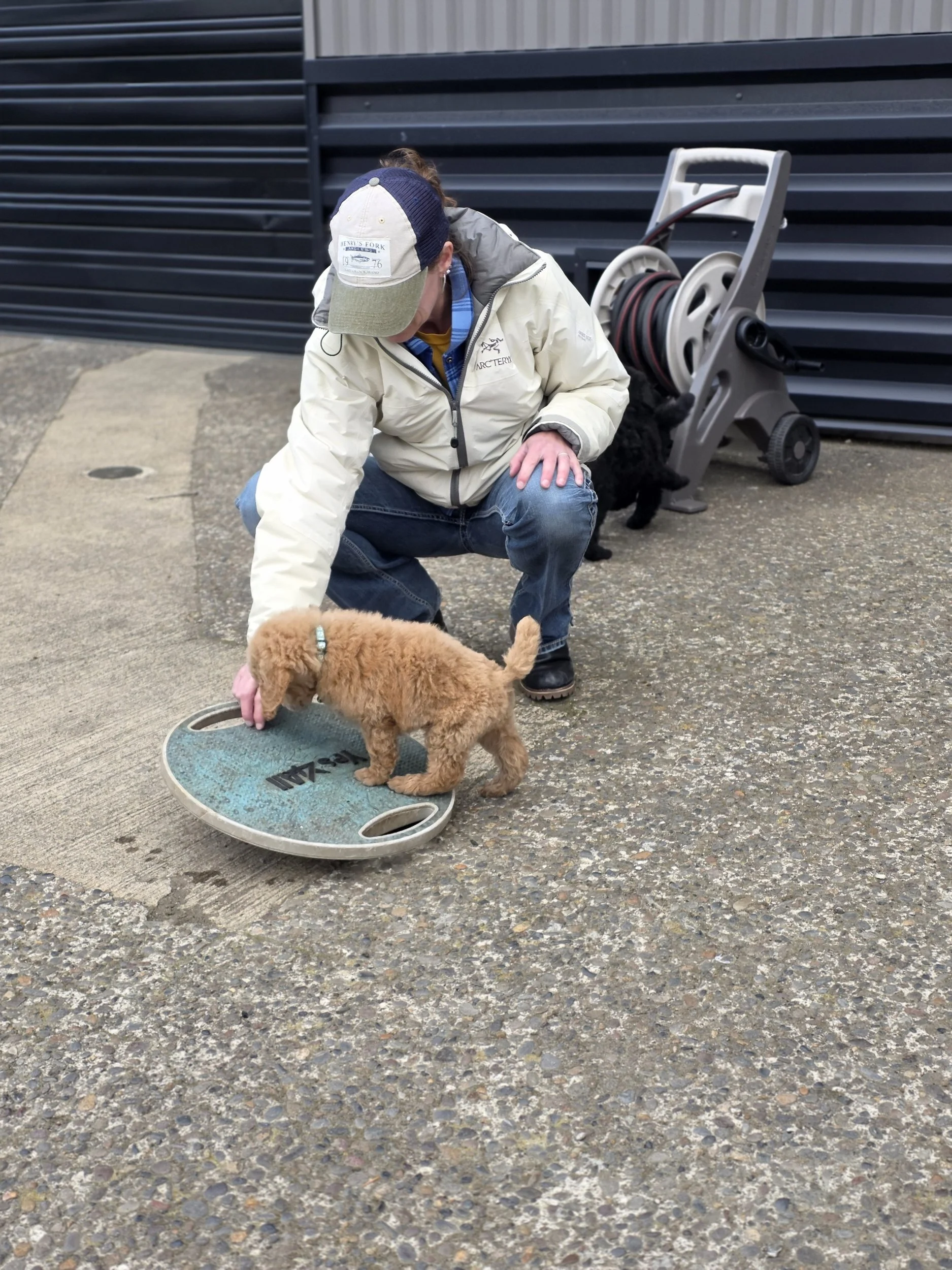
As you get to know each puppy, I encourage you to keep an open mind.
It's easy to fall in love with a particular face, a favorite name, or the puppy who's stolen your heart in photographs. But just like that first crush beneath the midway lights, the one who initially catches your eye isn't necessarily the one who's meant to stay by your side for the next 12 to 15 years.
Think about the life you want to share. Are you looking for an enthusiastic companion who's always ready for the next adventure? A clever partner who loves learning new things and figuring out challenges? Or a more easygoing personality who's just as happy enjoying a quiet evening at home as joining in the excitement?
There isn't one best puppy at this county fair. There are five individuals, each with their own strengths, personalities, and ways of approaching the world.
My goal is to help you look beyond appearances and find the companion whose temperament, energy, and needs are most compatible with your lifestyle.
Because finding your perfect puppy isn't about choosing the brightest lights or the most exciting ride. It's about finding the one who makes even the ordinary moments feel a little magical.
Thank you for trusting me with these five little lives. Watching them grow alongside their Safari friends, discover the world, and develop their own personalities has been such a wonderful experience. Now comes one of my favorite parts—helping each of them find the family who will love them long after their county fair adventure comes to an end.
The midway lights may eventually go dark, the music may fade, and the last ride may come to a stop, but the best love stories don't end when the fair closes.
Sometimes, that's where they begin. ❤️

Temperament is about so much more than a single test. Throughout our time at the county fair, we've spent weeks observing each puppy as they explore new experiences, navigate challenges, interact with people and littermates, and discover the world around them. These everyday adventures give us valuable insight into their confidence, curiosity, motivation, recovery, problem-solving abilities, and individual personalities.
And with nine Safari friends growing up right alongside them, our five little fairgoers have certainly had plenty of opportunities to learn, play, and find a little mischief along the way!
Each new experience adds another piece to the puzzle, helping us understand not just how a puppy responds in one moment, but how they approach life as a whole.
This is a lengthy Pupdate, packed with important information about our five little stars of the midway, so please take your time reviewing their temperament evaluations, videos, and my personal recommendations before making your selection.
Once all reservation holders have completed their selections, we'll update the Available Puppies page with any remaining puppies.
After puppy selections are finalized, we'll begin following up with families who have been waiting for availability updates, as well as applicants who may be better suited for one of our upcoming litters.
The tickets are ready, the midway lights are glowing, and our five little stars are waiting. Let's meet the puppies and find out who might be going home with you! 🎡

Click the admission ticket to view the complete temperament evaluation spreadsheet, including scoring, observation notes, and individual results for each of our five County Fair puppies.
Behind the Midway Lights: Understanding Temperament Evaluations
Alright… so you've grabbed your admission ticket, opened the temperament spreadsheet, and thought:
"Whoa… what exactly am I looking at?!"
Fair enough!
There's a lot of information packed into those evaluations, and making sense of all those numbers, categories, and observations might feel a little like trying to find your way through a crowded midway after dark!
But don't worry. You don't need to know how every ride works to have a wonderful night at the fair!
Over the next few sections, I'll walk you through the evaluations, explain what we're measuring, and help you understand how to interpret the results. More importantly, we'll look at how those scores translate into everyday life and what they might mean for your future puppy.
Remember, a temperament evaluation is a snapshot, not a crystal ball. My recommendations are based on much more than a single testing session. They're informed by seven weeks of watching these puppies grow, learn, recover, solve problems, interact with their world, and develop their individual personalities.
And because our County Fair puppies have grown up alongside their Safari friends, we've had plenty of opportunities to observe them in all kinds of situations, from quiet one-on-one interactions to the wonderful chaos of fourteen puppies playing together!
Think of the spreadsheet as your admission ticket, the evaluations as a peek behind the midway curtain, and my recommendations as your personal guide to finding the puppy who's the best fit for your family.
Ready? Your ticket's been punched. Let's head inside! 🎟️

Learn how to navigate the County Fair Litter temperament evaluation spreadsheet, compare Ginger and Stryker's five little fairgoers side-by-side, and follow along as families make their selections to see which puppies are still available.
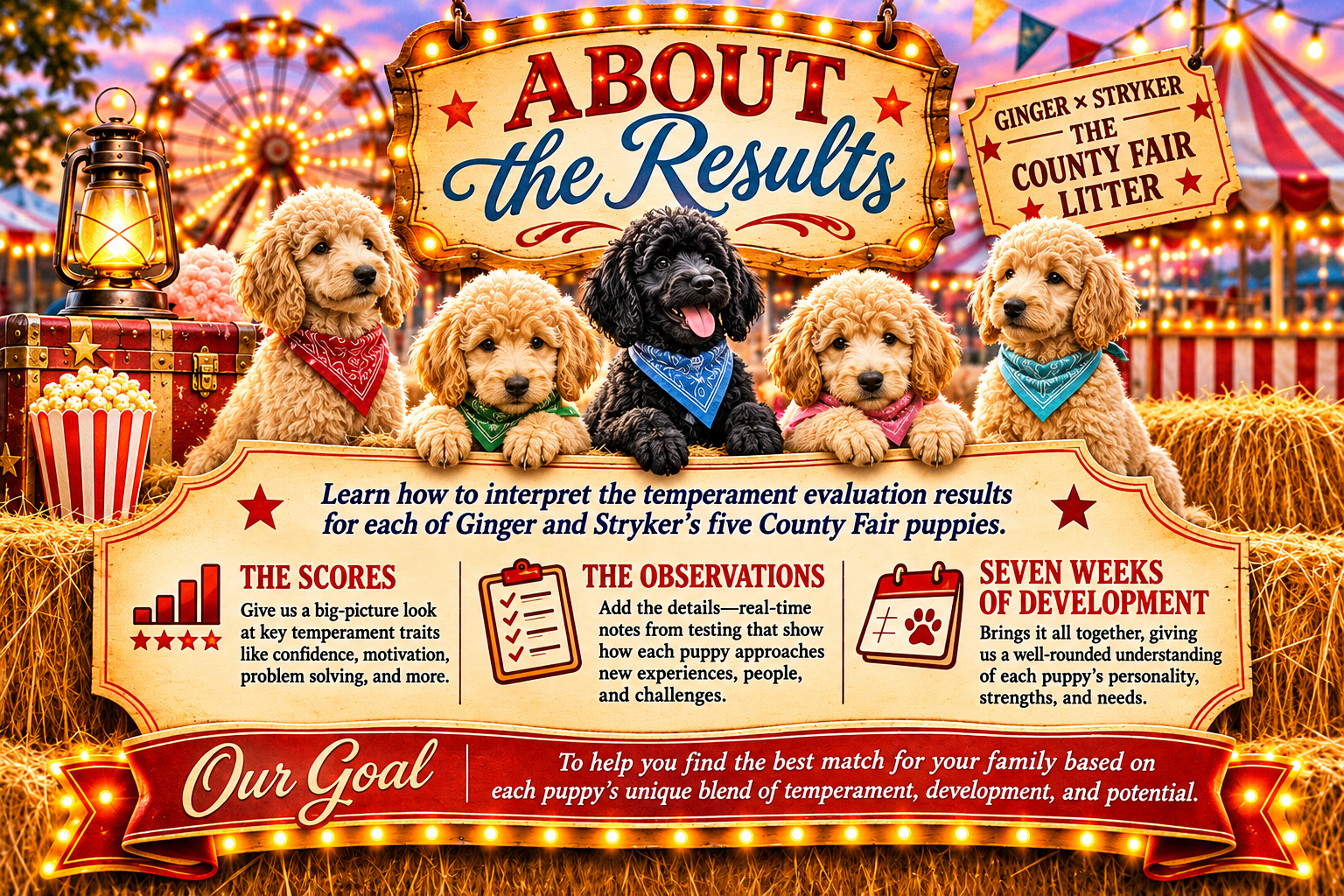
Learn how to interpret the temperament evaluation results for Ginger and Stryker's five County Fair puppies, and discover how their scores, individual observations, and seven weeks of development help us identify the best match for each family.
Puppy Evaluations
Every puppy approaches the world a little differently, and our temperament evaluations are designed to help us understand those differences.
Our evaluations provide insight into how each puppy naturally interacts with the world while respecting their emotional development, autonomy, and trust.
Rather than putting puppies through rigid or unnecessarily stressful testing, we focus on observing their confidence, engagement, recovery, problem-solving abilities, environmental stability, adaptability, and workability.
Throughout the evaluation, puppies encounter unfamiliar environments, surfaces, objects, handling, and challenges. We're interested not only in what they do, but how they approach an experience, what motivates them, and how they respond when something doesn't go quite as expected.
The goal isn't to manufacture stress or see how much a puppy can tolerate. It's to give them opportunities to explore new experiences while allowing their natural personalities and developing skills to emerge.
Over the years, I've found this approach provides a more complete and realistic picture of each puppy while remaining consistent with our Puppy Culture philosophy.
How Is the Evaluation Performed?
Every visit to the midway begins with a little exploration!
The evaluator starts seated quietly in the testing area while the puppy is brought into the unfamiliar environment and given time to settle in.
During these first moments, the puppy is free to investigate their surroundings, explore toys, interact with the evaluator, or simply sit back and take everything in.
There's no rush to get started. How a puppy chooses to approach a new environment can tell us quite a bit before we've even introduced the first activity.
Once the puppy is comfortable, we gradually introduce different experiences, including:
Toy engagement and play
Problem-solving challenges
Navigating obstacles and equipment
Exploring novel and unstable surfaces
Recovery from unexpected experiences
Handling and grooming tolerance
Environmental adaptability
The evaluation is intentionally flexible rather than rigidly scripted. We follow the puppy's responses, allowing opportunities for encouragement, exploration, and independent decision-making.
One of the most important things to understand is that our puppies always have a choice.
A puppy might tell us:
"I'm not sure about that."
"Give me a minute to figure this out."
Or even, "No thanks. Not interested!"
And that's okay!
We may encourage, guide, coax, or coach a puppy through a challenge, but we don't force participation. Sometimes a puppy's decision to avoid an activity tells us just as much as watching another puppy confidently tackle it.
If a puppy becomes overwhelmed, we can pause, give them time to recover, or end the evaluation altogether. Their emotional well-being always comes first.
We're not looking for puppies who blindly complete every task. We're looking to understand how each puppy thinks, responds, communicates, and navigates the world.
There are no passing or failing grades at our county fair!
Traits Evaluated
Our temperament evaluations consider both relatively stable developmental tendencies and characteristics that can be influenced by experience, environment, training, and maturity.
Each trait is scored on a scale of 1–5, but it's important to remember that a higher number doesn't automatically mean a better puppy. Different traits and combinations of traits are desirable for different homes and purposes.
Stable Traits
Scored from 1–5, with 5 representing a higher expression of the trait.
Assertiveness with humans
Assertiveness with other dogs
Motivation
Energy level
Intensity
Human focus
Tenderheartedness
Adjustable Traits
Scored from 1–5, with 5 representing a higher expression of the trait.
Confidence
Nerve strength / resiliency
Touch tolerance (compliance, not necessarily enjoyment)
Sensitivity Traits
These categories use a sensitivity scale:
1 = Little to no sensitivity
5 = High sensitivity
Sound sensitivity
Sight sensitivity
Remember, these scores are not a ranking of our five fairgoers from best to worst. They're simply another way of understanding what makes each puppy unique.
A confident, highly motivated, intense puppy may be an exciting prospect for an experienced performance home, while a more moderate, easygoing puppy may be a wonderful match for a family looking for a companion.
The goal isn't to find the puppy with the highest scores or the one who puts on the biggest show. It's to find the puppy whose combination of traits makes them the right companion for you, long after the midway lights go dark.
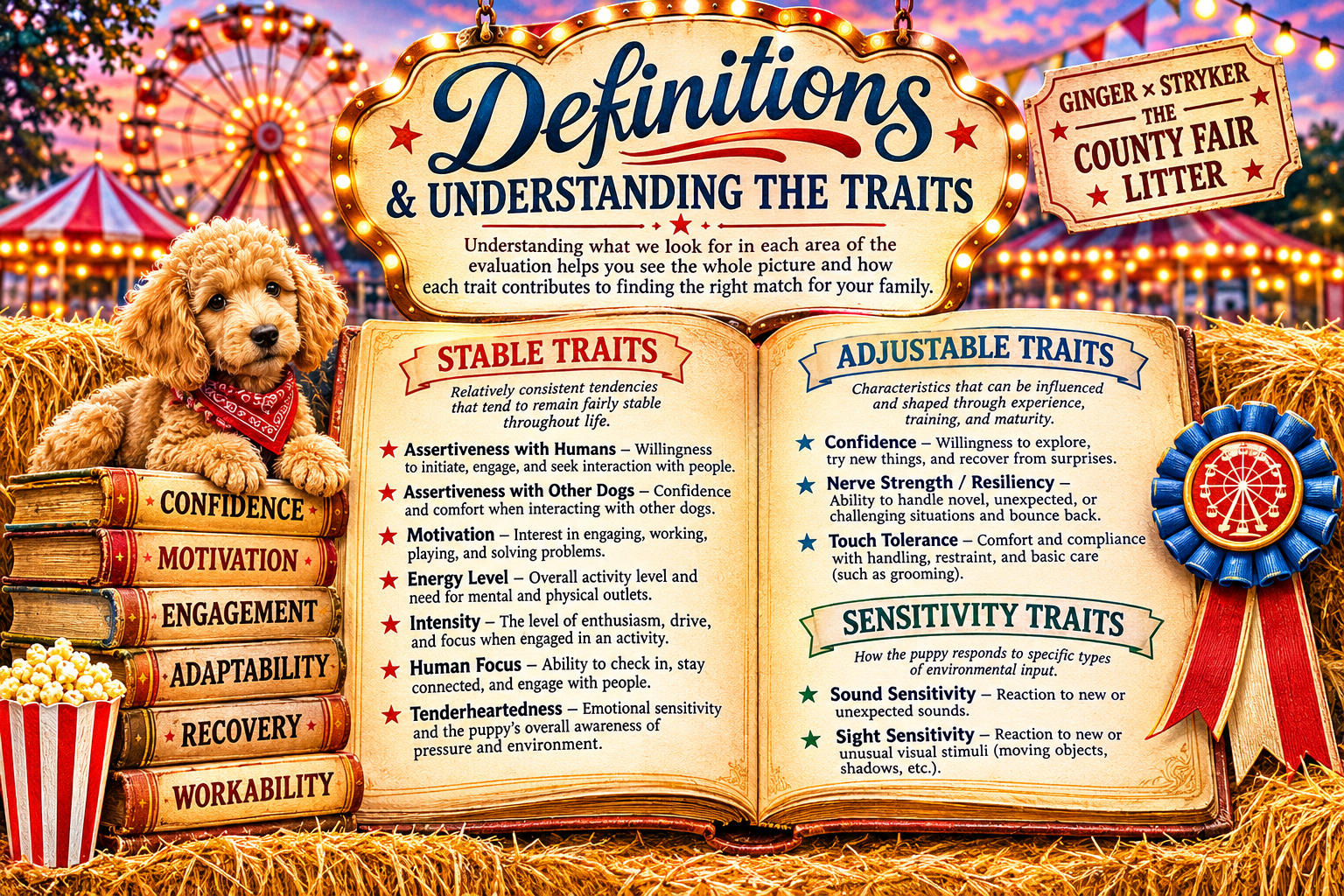
Learn what each temperament trait reveals about Ginger and Stryker's five County Fair puppies, why those characteristics matter, and how their individual strengths and personalities help us find the perfect companion for each family's adventures.
Definitions & Understanding the Traits
Human Assertiveness
Human assertiveness is not aggression. It describes how readily a puppy approaches people, initiates interaction, and makes themselves part of whatever you're doing.
Our more assertive little fairgoers are often the puppies who:
Climb straight into your lap without an invitation.
Enthusiastically greet new people.
Insist on investigating everything you're doing.
Would happily steal your funnel cake if you weren't paying attention!
These puppies tend to be socially confident, outgoing, and very comfortable inserting themselves into human activities.
Higher human assertiveness can be particularly valuable in certain working roles, including diabetic alert, psychiatric service work, and behavior interruption tasks, where a dog may need to initiate interaction independently.
Of course, there's a flip side! These enthusiastic little personalities need consistent boundaries and guidance as they mature. Without it, their eagerness to engage can turn into jumping, pushiness, or difficulty controlling their impulses.
The takeaway: A highly assertive puppy may be a wonderful partner for someone who enjoys an outgoing, interactive dog, but they also need a family willing to teach appropriate manners.
Prey Drive / Intensity
When people hear "prey drive," they often picture a dog chasing squirrels or cats. But there's much more to it than that!
For our evaluations, we're looking at the intensity with which a puppy engages with toys, movement, play, and other stimulating experiences.
You might see this in a puppy who:
Becomes completely focused on a moving toy.
Enthusiastically grabs, tugs, or shakes toys.
Loves chasing and interactive games.
Remains engaged even when a task becomes challenging.
Has a particularly enthusiastic, all-in approach to play.
Higher-intensity dogs can be exciting partners for performance sports, scent work, advanced training, and other activities that provide appropriate outlets for their energy and motivation.
However, intensity isn't automatically the same thing as trainability, and more isn't always better.
These dogs often need help learning when to engage, when to disengage, and how to settle when the excitement is over.
The takeaway: A high-intensity puppy can be a fantastic match for an active, training-oriented home, while a puppy with more moderate intensity may be easier to live with for a family seeking a relaxed companion.
Nerve Strength / Resiliency
Even the most confident puppy can be surprised by something unexpected. What matters isn't necessarily whether something startles them, but how they respond afterward.
Nerve strength and resiliency describe a puppy's ability to navigate uncertainty, adapt to new environments, and recover from experiences that may initially cause hesitation.
We're observing things like:
How quickly a puppy recovers after being startled.
Their willingness to investigate unfamiliar objects.
How they approach new surfaces or environmental challenges.
Whether they regain confidence after something unexpected.
How readily they return to exploring or engaging.
This is considered an adjustable trait, meaning experience, environment, training, and continued confidence-building can influence its development.
A puppy who needs a little more encouragement at seven weeks isn't necessarily going to be an insecure adult dog. Likewise, a particularly bold puppy still needs thoughtful socialization and positive experiences.
Our Puppy Culture curriculum is built around helping puppies develop these skills, but that work doesn't end when they go home.
The takeaway: Resiliency is an important consideration for any home, particularly those expecting a dog to regularly navigate busy, unpredictable, or unfamiliar environments.
Tenderheartedness
Tenderheartedness is one of the more interesting traits we evaluate, and one that families don't always think about when choosing a puppy.
It describes how sensitive and responsive a puppy appears to be toward human emotions, tone, and social interactions.
Our more tenderhearted puppies may be especially responsive to changes in someone's voice, body language, or emotional energy.
These dogs often develop incredibly close relationships with their people and may be particularly attentive to subtle changes in their environment.
Tenderheartedness can be a desirable quality in companion dogs and certain therapy or support roles, although it doesn't independently determine suitability for those jobs.
There are also some important considerations.
A highly emotionally sensitive dog may find a household with frequent yelling, unpredictable interactions, or intense emotional activity more challenging than a dog who is naturally less affected by those experiences.
That doesn't mean tenderhearted dogs can't live in busy families or alongside people experiencing anxiety, PTSD, or other emotional challenges. It means we need to consider the individual dog's coping skills, resilience, and comfort with that environment.
The takeaway: Tenderheartedness can contribute to a wonderfully connected relationship, but the right match depends on how that sensitivity combines with the puppy's confidence, resiliency, and other traits.
Touch Tolerance
Touch tolerance is particularly important for Standard Poodles, considering how much grooming and handling they'll experience throughout their lives!
This trait isn't simply about whether a puppy enjoys being touched. We're looking at how they respond when handling becomes inconvenient, unfamiliar, or mildly uncomfortable.
Some puppies are remarkably easygoing and seem perfectly content with nearly everything we do.
Others may communicate their discomfort by:
Pulling away or repositioning themselves.
Becoming still or hesitant.
Wiggling, resisting, or attempting to leave.
Showing signs that they need a break.
Those responses provide valuable information about the puppy's comfort level and communication style.
It's important to distinguish between a puppy who genuinely enjoys handling and one who simply tolerates it. A puppy who remains still isn't necessarily relaxed, and compliance shouldn't automatically be interpreted as comfort.
Touch tolerance is especially relevant for grooming, veterinary care, cooperative husbandry, and households with children.
We've already introduced our puppies to regular grooming and daily handling, but continued positive experiences will be important as they mature.
The takeaway: A puppy with lower touch tolerance isn't necessarily a poor companion. They may simply need a more deliberate approach to cooperative care, handling, and building trust.
Putting It All Together
As you work through these definitions, remember that no single trait tells the entire story of a puppy.
A highly assertive puppy with excellent resiliency may navigate the world very differently from an equally assertive puppy who is more environmentally sensitive.
Likewise, a tenderhearted puppy with strong recovery skills may be well suited to situations that would overwhelm another puppy with a similar tenderness score.
It's the combination of traits, daily observations, and individual development that helps us understand each of our five County Fair puppies.
Some puppies are drawn to every flashing light, exciting sound, and opportunity to join the fun. Others are perfectly content to take in the sights from a quieter spot on the midway. Neither approach is inherently better.
We're not searching for perfect scores. We're searching for the right combination of qualities for the life you want to share.
Because when the fair is over and the lights go out, what matters most isn't which puppy put on the biggest show.
It's which one belongs beside you on the ride home. 🎡
The Recordings
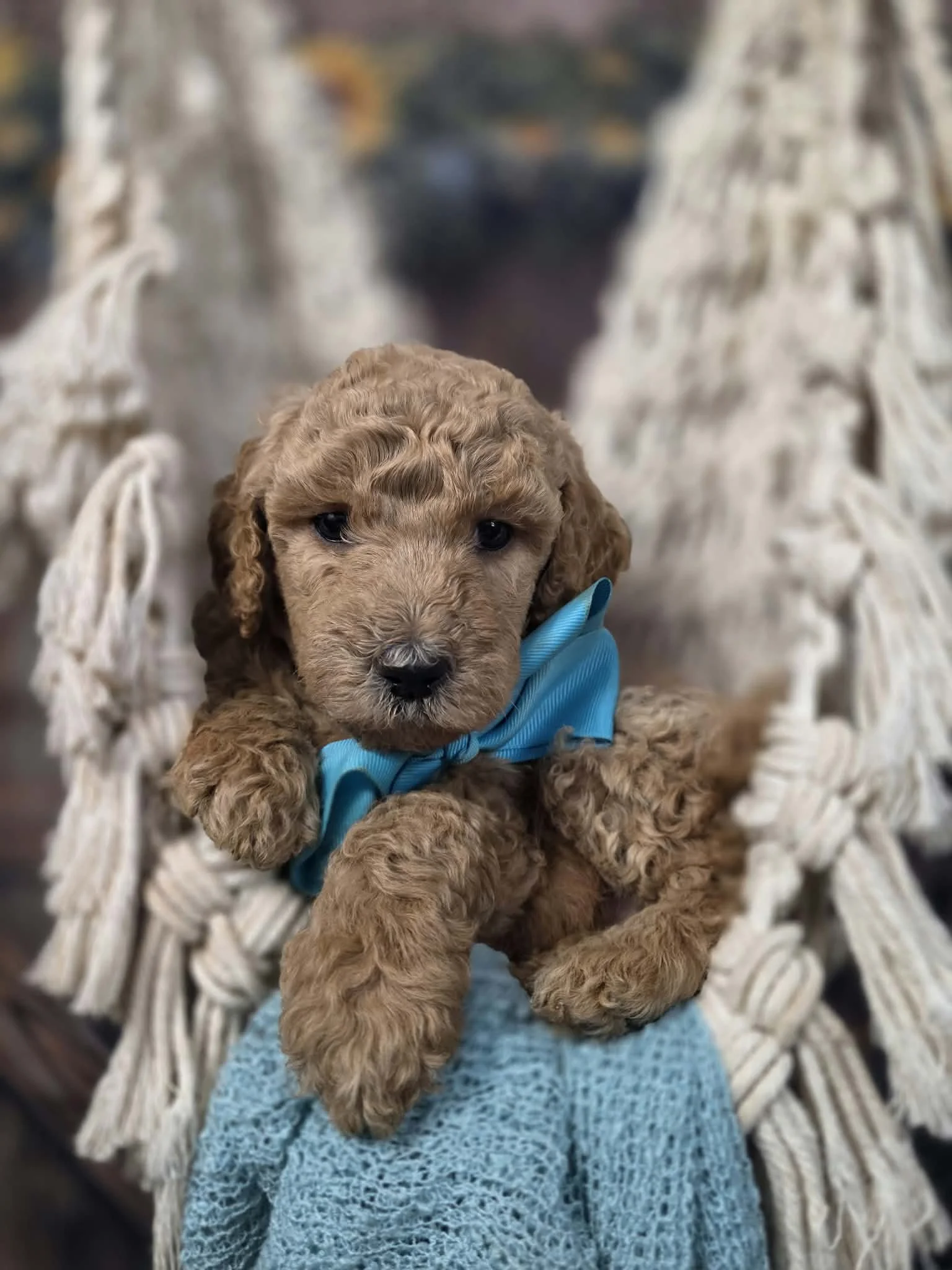
Lantern - Most Likely To Make You Feel Special
Lantern apparently missed the memo that temperament testing was supposed to be an evaluation. As far as he was concerned, someone had invited him to spend a little quality one-on-one time with his favorite kind of company, and he was absolutely delighted!
He wasted no time getting acquainted. Straight into his evaluator's lap, kisses all around, tail wagging a hundred miles an hour. There was no hesitation, no awkward introduction, and certainly no question about whether he was happy to be there.
And that's Lantern. He has a way of making you feel like you're the most important person in the entire world, even if you've only been paying attention to him for thirty seconds.
Of course, Lantern isn't opposed to a little entertainment. He had a great time playing with the toys during his evaluation, fetching them, shaking them enthusiastically, and even bringing one back to continue the game. But there was a recurring theme throughout the test. He'd get interested in a toy, play with it for a bit, and then remember there was a PERSON available.
And people are WAY more interesting than toys!
One of the things I particularly like about Lantern is that his enthusiasm for people doesn't come from a lack of confidence. He's a very confident puppy who seems quite comfortable exploring his environment and making decisions for himself.
In fact, Lantern has developed a rather funny obsession with our puppy slide. He LOVES that thing! He'll willingly climb up it all by himself, and apparently he's decided that the top is an excellent place to sleep. During our Puppy Party, he was frequently spotted napping on the slide, and I've found him sleeping up there on numerous occasions myself. I can't say that I understand the appeal of sleeping on playground equipment, but Lantern certainly seems to think he's discovered something wonderful!
That same confidence was evident throughout his temperament evaluation. He's not particularly bothered by unfamiliar sights or sounds, and he demonstrated excellent nerve strength and resilience. He has plenty of energy and enthusiasm, but he's not quite as relentlessly busy as some of the other puppies we've evaluated.
There was one interesting moment during testing that gave us something to think about. When his evaluator introduced emotional distress and commotion, Lantern definitely noticed. Initially, he seemed to want to engage with her, almost as though he was trying to figure out what was happening. But as the situation continued, he appeared to become somewhat uncomfortable himself.
Once things settled down, however, he was able to move past the experience and return to playing.
We've also noticed that Lantern pays attention when other dogs start barking or making a fuss. He's aware that something is happening, and he seems interested in what they're communicating, but he doesn't necessarily feel compelled to join in. I appreciate that about him. Being aware of your surroundings is a good thing. Feeling obligated to participate in everybody else's drama is another matter entirely!
I think Lantern has the potential to be a really enjoyable dog to train. He's confident, highly motivated, and genuinely interested in interacting with people. His enthusiasm should translate nicely into obedience, rally, tricks, and other activities where working together is part of the fun. While he enjoys toys, I wouldn't necessarily expect him to be the dog who lives and breathes for a ball or an opportunity to chase something.
The biggest thing I'd encourage his future family to remember is that all this wonderful human focus comes with a responsibility to teach independence. Lantern doesn't need someone encouraging him to be MORE interested in people. He's already got that part figured out! What he'll need is someone willing to establish boundaries, encourage independent activities, and make sure he learns that being alone occasionally is perfectly okay.
I see Lantern doing particularly well with an active individual, couple, or family who wants a dog who's involved in everyday life. He has the confidence to accompany his people on adventures, the enthusiasm to participate in activities, and the affectionate nature to make even ordinary moments enjoyable. He doesn't need a professional sporting career to be happy, but I do think he'd appreciate a family that enjoys doing things with their dog.
And while his interest in people could make him worth considering for certain therapy or service-related activities, I'd want to know more about his response to human emotional distress before making any big predictions in that direction.
Ultimately, Lantern is a wonderfully social, enthusiastic puppy who seems to take genuine pleasure in making connections with people. He's got plenty of personality, a healthy dose of confidence, and just enough of his own peculiar interests to keep life entertaining.
I suspect Lantern's future family is going to spend a lot of time feeling like they're the most important people in the world. And the funny thing is, as far as Lantern is concerned, they probably will be.
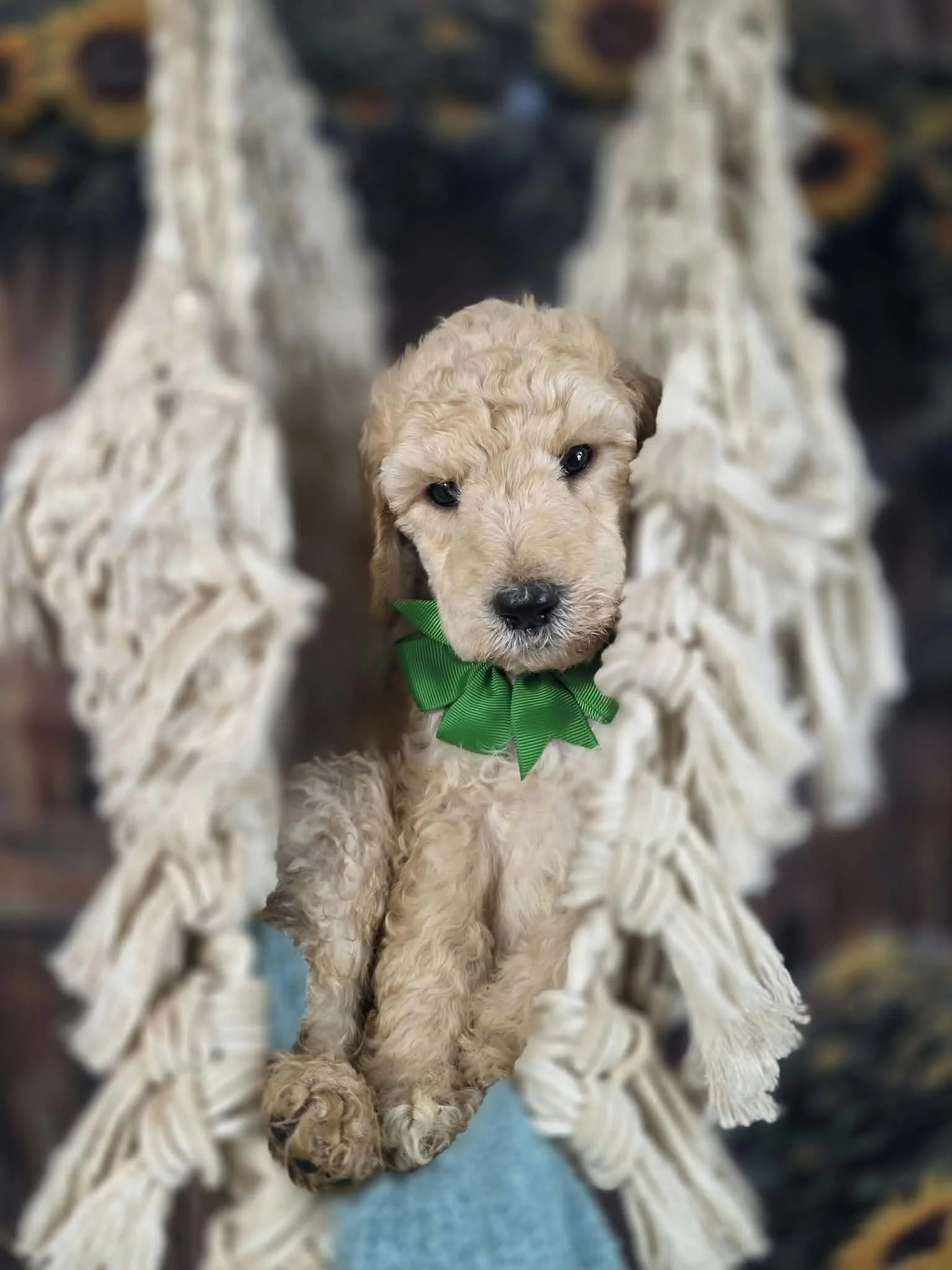
Ferris - Most Devoted
Ferris has a very clear idea of what makes a good day: you’re there, you’re paying attention to him, and preferably you haven’t stopped petting him.
During temperament testing, he came right into the evaluator’s lap with a tail that was threatening to turn into a helicopter. There were toys available. There were things to explore. But there was also a perfectly good person sitting right there, and Ferris had his priorities.
Those are very nice toys. Have you considered petting ME?
What I love about Ferris is how freely he offers that affection. He wasn’t waiting for something to worry him before seeking out a person. He arrived ready to make a connection. He wanted to be close, participate, follow along, and find out what his new friend was doing. Human interaction was the reward, not simply a means of getting something else.
And despite all that enthusiasm, Ferris wasn’t a puppy who needed to be running at full speed throughout the evaluation. We described his energy as very pleasant. He could settle with the evaluator, and when she became more animated, he was interested in joining her. When we discussed his energy level, our description was essentially, “Whatever yours is.”
That distinction matters. Ferris puts a lot of enthusiasm into loving someone. That is not the same as needing nonstop activity!
His confidence, however, doesn’t always keep pace with his desire to participate.
Ferris was considerably more certain about approaching a person than he was about approaching some of the unfamiliar challenges. He needed encouragement for certain obstacles, and he can be very vocal during difficult moments. His reactions were not something we could simply ignore, but neither did they tell the whole story.
The umbrella produced a substantial startle. He returned to the evaluator first, then investigated it with her encouragement. That was a supported recovery, rather than a puppy who immediately decided everything was fine on his own.
But the moment I keep coming back to happened at the slide. After initially finding the challenge difficult, Ferris completed it with encouragement. Later, he went back and did it voluntarily, without the earlier screaming.
He didn’t just get through it. He chose to try again.
That is something I want his future family to understand about him. Ferris showed uncertainty, but he also showed us that a successful experience could be followed by greater willingness. He needs opportunities to discover what he can do, with someone who appreciates the progress rather than becoming frustrated that he needed help in the first place.
He was also particularly responsive during the part of the evaluation when the evaluator pretended to be upset. Suddenly, reaching her seemed important enough to attempt an obstacle that had previously challenged him. Our description in the moment was, “I will climb the mountain to get to you.”
I wouldn’t turn that into a promise about a future job. But it was a striking example of how strongly connection motivated him.
For Ferris, our guiding phrase became “empower, don’t enable.” That means helping him build confidence through manageable successes—not withholding affection or expecting him to push through everything without support. His person needs to be patient, steady, and able to celebrate a small accomplishment without making every uncertain moment a crisis.
Comfortable independence will also need to be a deliberate part of raising him. Ferris has plenty of enthusiasm for being with people. Learning that he can rest, entertain himself, and spend comfortable time apart deserves attention too. The goal isn’t to make him less affectionate. It’s to help him feel capable even when someone isn’t right beside him.
During testing, we found ourselves talking about Ferris as a companion for a little boy. I understand why. There is something appealing about a puppy who finds spending time with his person so rewarding. I can picture him enjoying a child’s company, learning little tricks together, and being thoroughly delighted when his friend comes home from school.
The adults, of course, need to be responsible for his training, confidence-building, and time apart. A respectful child could be a wonderful friend; they shouldn’t have to be his entire support system.
I see Ferris fitting well with affectionate adults or a thoughtful family who wants a close, involved companion. His moderate energy leaves room for both relaxed time together and everyday activities. I’m prioritizing that kind of partnership over placing him with the expectation that he must succeed in a demanding working role.
Ferris doesn’t need someone who wishes he were a different puppy. He needs someone who enjoys his affectionate enthusiasm, understands his uncertainty, and takes pleasure in helping him discover that he can do things.
There was a whole room to explore during his evaluation.
Ferris’s favorite part was the person sharing it with him.
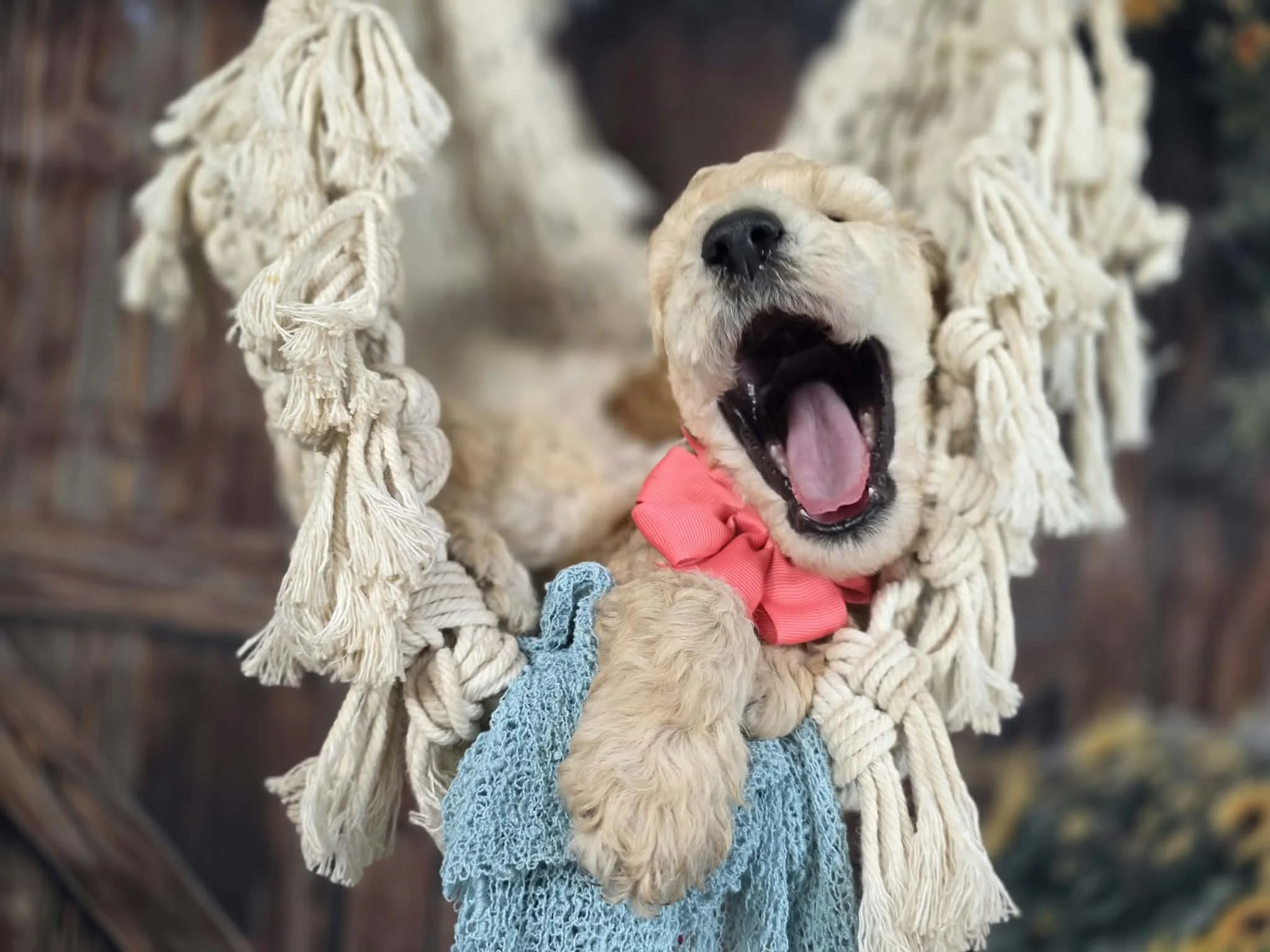
Kettle - Most Likely To Go All In
If Kettle had a wristband for the county fair, he'd be determined to get his money's worth. Every ride, every game, every attraction, and probably a few things that weren't technically included in the admission price!
Kettle is not a puppy who believes in doing anything halfway.
From the beginning of his temperament evaluation, Kettle made it clear that he was born ready. Ready to play, ready to explore, and ready to find out what else we had planned for him. He's confident, enthusiastic, highly motivated, and convinced that the world is full of things worth experiencing.
And he'd very much appreciate it if we could get on with experiencing them!
Give Kettle a toy, and he doesn't just politely investigate it. He grabs it, shakes it, and puts some real enthusiasm into the game. But what makes Kettle especially interesting is that he's just as interested in the people involved. He wants to participate with you, without needing constant reassurance or permission to enjoy himself.
He's also perfectly capable of having his own ideas. Quite a few of them, actually!
One of my favorite moments during testing came when we introduced the unexpected. The sudden popper barely registered, while the umbrella caught him by surprise for just a moment. Rather than retreating, Kettle's response was essentially, "What is THAT?" And then he wanted to investigate.
That's the kind of resilience I love seeing. Confidence isn't necessarily about never being startled. It's about what happens afterward, and Kettle showed us a puppy who recovers quickly and approaches the unfamiliar with curiosity.
Of course, he also gave us a few opportunities to discuss the finer points of appropriate behavior!
During the more exciting portions of his evaluation, Kettle had some energy to burn. There was running, enthusiasm, and eventually the unfortunate decision that the evaluator's legs might make an entertaining outlet for all that excitement.
Apparently, someone needed to remind Kettle that there are rules at the fair.
Kettle has plenty of enthusiasm, but enthusiasm and self-control are two different things. His future family will need to encourage his confidence and motivation while teaching him that not every exciting feeling requires an equally exciting response.
Around here, we have a saying: "Do not reward the crazy!"
Kettle also made his opinions about physical handling known. When picked up, his response was essentially, "That was not cool, man. I'd prefer you didn't do that again!"
That's something we'll want to continue working on. He's a Poodle, after all, and grooming inevitably involves some handling that isn't particularly negotiable. Teaching him to cooperate comfortably, even when he'd rather be doing something else, will be important. Encouragingly, he recovered and returned to interacting with us without dwelling on the experience.
But perhaps the most interesting observation of the entire evaluation was how much Kettle reminded me of his grandma, Lola.
Lola has been one of the easiest dogs I've ever owned, so when I recognize some of her qualities in a puppy, I pay attention.
It's the combination of confidence, resilience, and an uncomplicated approach to life. Kettle doesn't seem inclined to worry about every little thing or allow minor disappointments to ruin his day. He's ready to get on with whatever comes next.
There's a difference between a puppy who's constantly busy because he's worried and one who's busy because he's confident, curious, and thoroughly enjoying himself. Kettle strikes me very much as the latter.
And that's why I see so many possibilities for this boy.
His motivation, confidence, and resilience make him an exciting performance prospect. His strong human focus and environmental stability also give him qualities worth considering for service work, provided he develops the composure and impulse control those responsibilities require.
But Kettle doesn't need a job title to be a wonderful companion.
I think he'd make a terrific family dog, especially with children who enjoy playing, training, and including their dog in their adventures. And I wouldn't rule out a quieter household willing to provide engagement and structure. He doesn't need constant entertainment; he needs people who appreciate his enthusiasm while helping him learn when it's time to settle.
The goal isn't to exhaust Kettle until he stops moving. It's to teach him that there's a time to go and a time to relax.
What makes Kettle special isn't simply his energy. It's that he's confident enough to try, motivated enough to participate, resilient enough to recover, and interested enough in his people to make the adventure something they can enjoy together.
Whether he's learning a new skill, heading out on an adventure, or discovering the pleasures of a quiet afternoon at home, I suspect Kettle will approach life the same way he approaches everything else.
He's going all in.
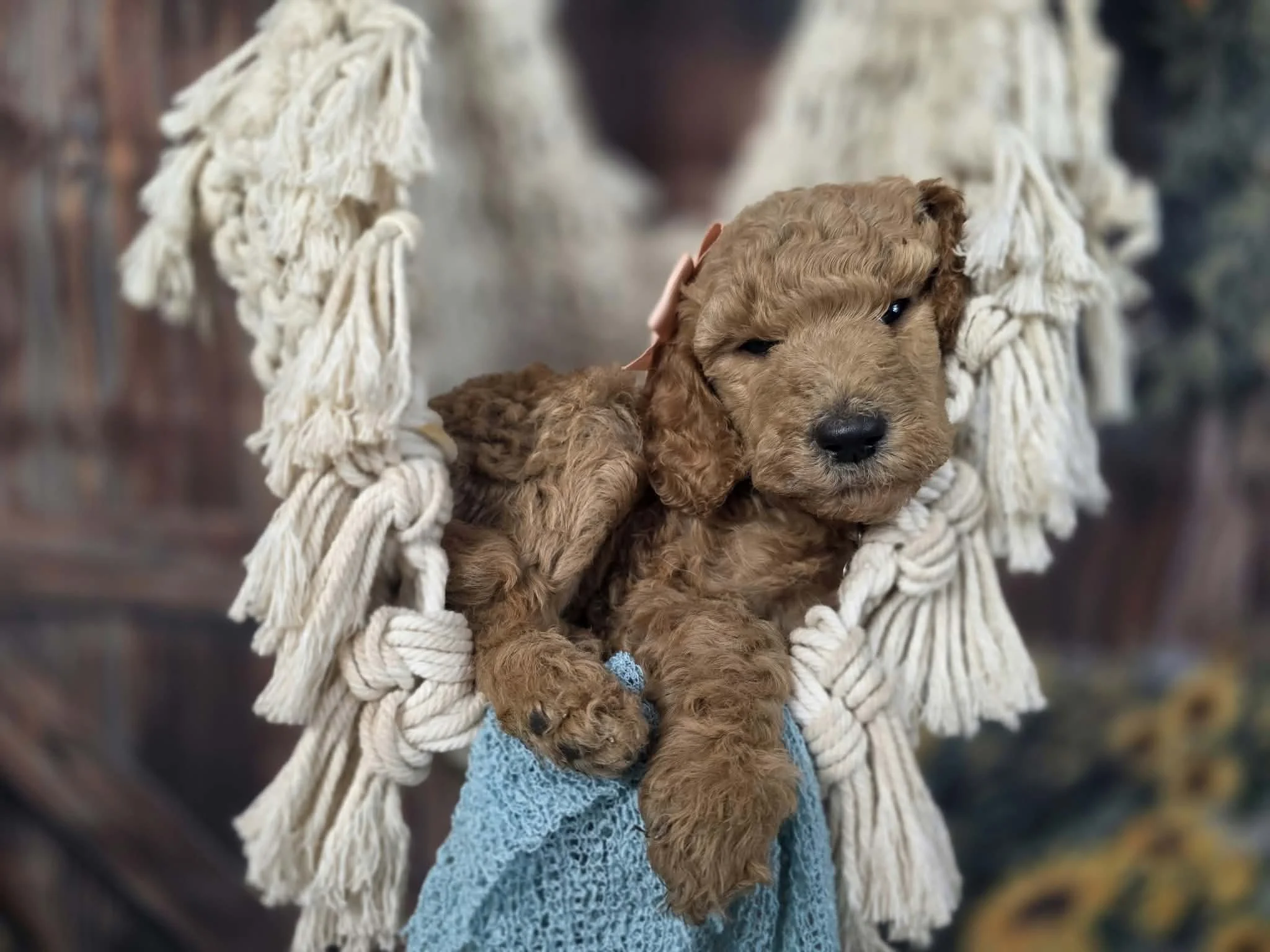
Midway -
Midway has apparently decided that life is one big playground, and she intends to enjoy every minute of it!
When we started her temperament evaluation, Midway had some very important business to attend to. There were toys to investigate, toys to shake, toys to carry around, and toys that apparently needed rescuing from wherever they'd gotten themselves stuck. Did she particularly care which toy she was playing with? Absolutely not! As far as Midway is concerned, a good toy is any toy she can get her paws on!
And if that toy happens to disappear somewhere inconvenient? Well, that's just another game! Midway demonstrated some particularly impressive nose work during her evaluation, using her sense of smell and plenty of persistence to locate a toy and figure out how to retrieve it. She's a little problem solver who genuinely enjoys the process of figuring things out.
But don't mistake all that enthusiasm for a puppy who doesn't appreciate her people! Once Midway decided we were worth investigating, she was more than happy to climb into a lap, wiggle her way into a cuddle, and deliver a generous helping of kisses. She's an affectionate little girl who enjoys human companionship without necessarily needing to be the center of someone's universe.
One of my favorite things about Midway is that she seems perfectly comfortable moving between those two worlds. She'll happily check in with her person, enjoy some attention, and then wander off to investigate something interesting. She's not particularly interested in being your shadow. She'd much rather know you're nearby while she gets on with the important business of having fun!
Midway also surprised us with how polite she was. Although she's one of the more assertive personalities in this litter, she wasn't particularly demanding or inclined to push boundaries. She has a lovely way of engaging with people without insisting that every interaction happen on her terms.
That doesn't mean she's completely fearless. During testing, we saw moments when Midway wanted to tackle a challenge but wasn't quite confident enough to follow through. She also needed a little time to decompress after some uncomfortable handling. On the other hand, when an unexpected noise gave her a significant startle, her curiosity kicked in almost immediately. Rather than retreating, she wanted to investigate what had happened! Those moments tell us she's a puppy with a nice foundation of resilience and some confidence still waiting to blossom.
I think Midway could be a wonderful addition to a family, including one with young, respectful children. She's playful, affectionate, entertaining, and has enough independence to enjoy herself when her people are busy. Her enthusiasm for toys and natural interest in using her nose could also make her a fun partner for someone interested in exploring scent work or other dog sports.
She may also have potential for therapy work with a handler who understands her communication and respects her boundaries around handling. She's a puppy who enjoys people, but we want that enjoyment to remain her choice.
Midway isn't a puppy who needs someone to create the excitement for her. She brings plenty of her own!
Give this girl a toy, a little room to explore, and people who appreciate her cheerful spirit, and she'll find the fun wherever she goes.
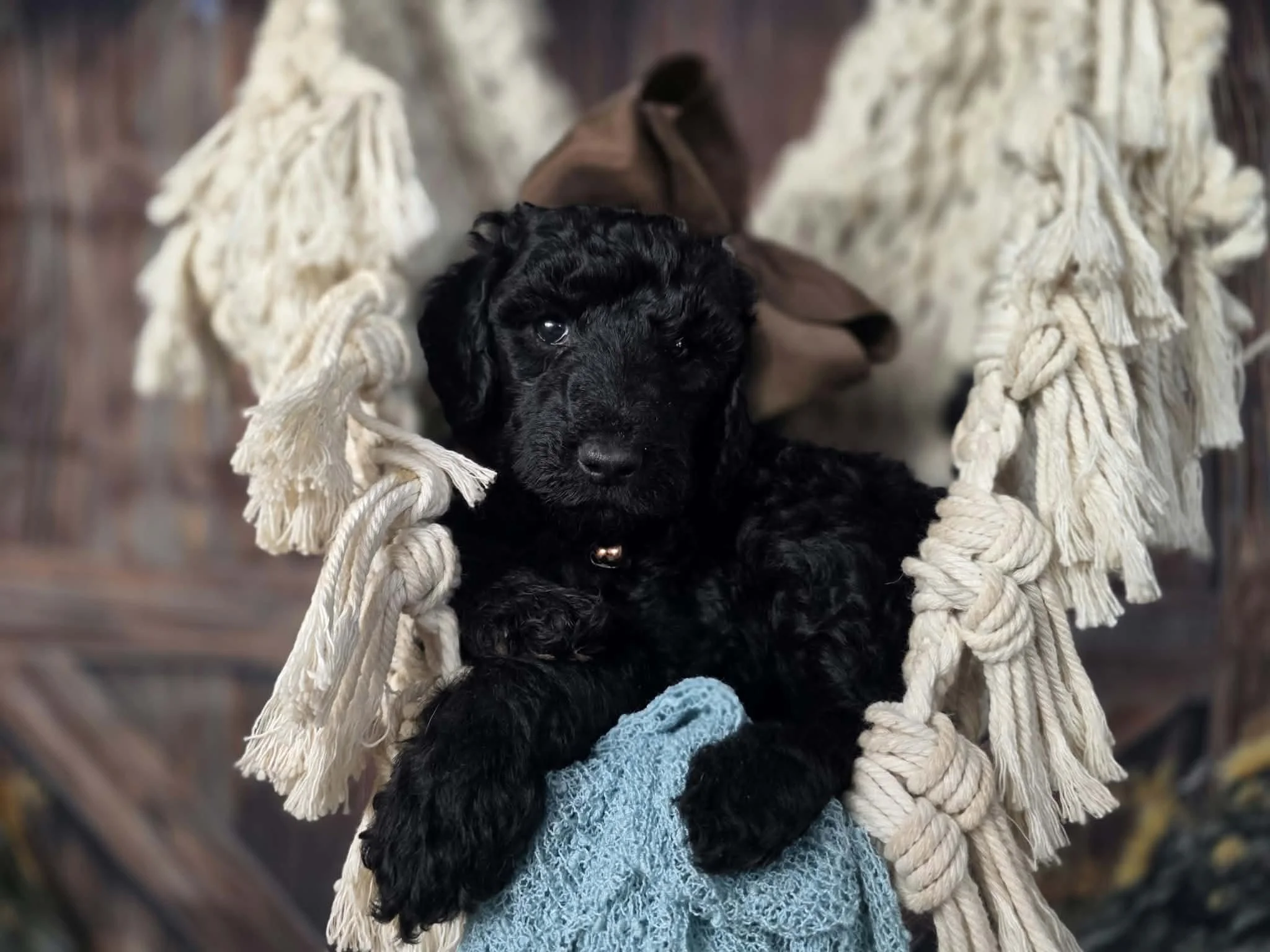
Carousel - Most Polite Party Girl
Carousel is a girl who loves a good time, but she'd really appreciate it if someone could clarify the rules before the party gets started!
She's outgoing, playful, affectionate, and absolutely delighted to interact with people. During her temperament evaluation, she wasted no time approaching, climbing into laps, and making herself part of the action. One of the things I particularly appreciate about Carousel is her wonderful eye contact. When she's interacting with you, she really looks at you! She's engaged, attentive, and interested in what you're doing, which is a lovely quality to build on in training.
But there was one particularly funny complication. Carousel has apparently been paying attention to all those manners we've been teaching, and she wasn't entirely convinced she was allowed to abandon them just because someone was encouraging her to!
There were several moments when you could practically see the wheels turning. I really, REALLY want to do that. But I'm pretty sure I'm not supposed to. Are you absolutely certain this is okay?
Once Carousel decides the fun is officially permitted, however, she's all in! She has a particularly entertaining way of playing, frequently using her front paws to bat at things almost like a cat. She thoroughly enjoyed wrestling with toys, giving them enthusiastic head shakes, and celebrating her victories. She's also wonderfully curious. At one point during testing, she caught an interesting scent and promptly set about investigating it, apparently deciding that whatever she'd discovered deserved her full attention.
One of the most interesting things about Carousel is the difference between her enthusiasm and her confidence. She genuinely wants to participate and enjoys interacting with people, but when something seems beyond her abilities, she can be quick to decide she can't do it. She's not particularly fearful, and she recovers beautifully from surprises. She simply doesn't always believe in her own abilities yet.
And this is where Carousel is going to need the right kind of guidance.
She needs a family who will help her develop confidence by empowering her rather than enabling her. When Carousel encounters something difficult, her people need to encourage her to figure it out rather than immediately stepping in to do it for her. That doesn't mean forcing her into situations she's uncomfortable with or expecting her to tackle challenges she isn't ready for. It means setting her up for success, giving her opportunities to make decisions, and allowing her to discover through experience that she's capable of more than she thinks. The goal isn't to protect Carousel from every moment of uncertainty. It's to teach her that she can work through those moments and come out the other side feeling pretty darn proud of herself!
Carousel is also an interesting combination of people-oriented and independent. She genuinely enjoys human interaction, and that lovely eye contact makes connecting with her particularly rewarding, but she doesn't require someone to entertain her every moment. If you're busy, she's quite capable of finding something else interesting to do! She's resilient, tolerant of handling, and not easily overwhelmed by the emotions or activity happening around her. She's also wonderfully responsive to boundaries, which means consistency will be important. Carousel is perfectly capable of learning excellent manners, but she's just as capable of learning that the rules are optional if her people aren't paying attention!
I can see Carousel being a wonderful companion for an active individual, couple, or family who enjoys including their dog in everyday adventures. She has the motivation and enthusiasm to make training fun, and I think she'd particularly enjoy learning tricks, playing games, or exploring recreational dog sports as her confidence develops.
Carousel doesn't need someone to convince her that life is fun. She's already figured that part out! She needs someone who will help her discover just how capable she really is—and occasionally remind her that it's perfectly acceptable to let her hair down and enjoy the party!
How Do I Pick My Puppy?
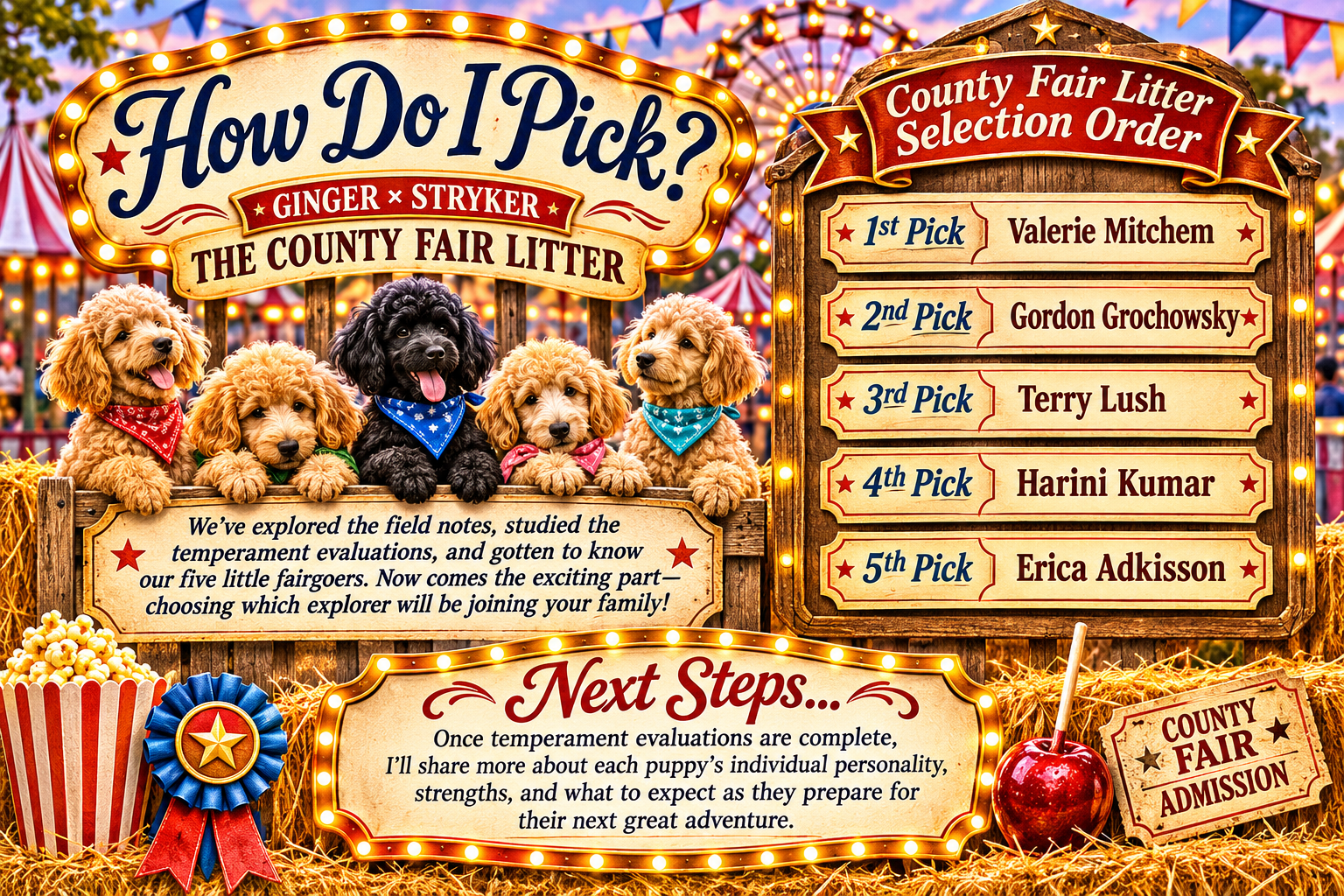
We've explored the temperament evaluations, gotten to know our five little fairgoers, and taken a good look at what makes each of them special. Now comes the exciting part—finding out which puppy will be heading home with you when the midway lights go dark!
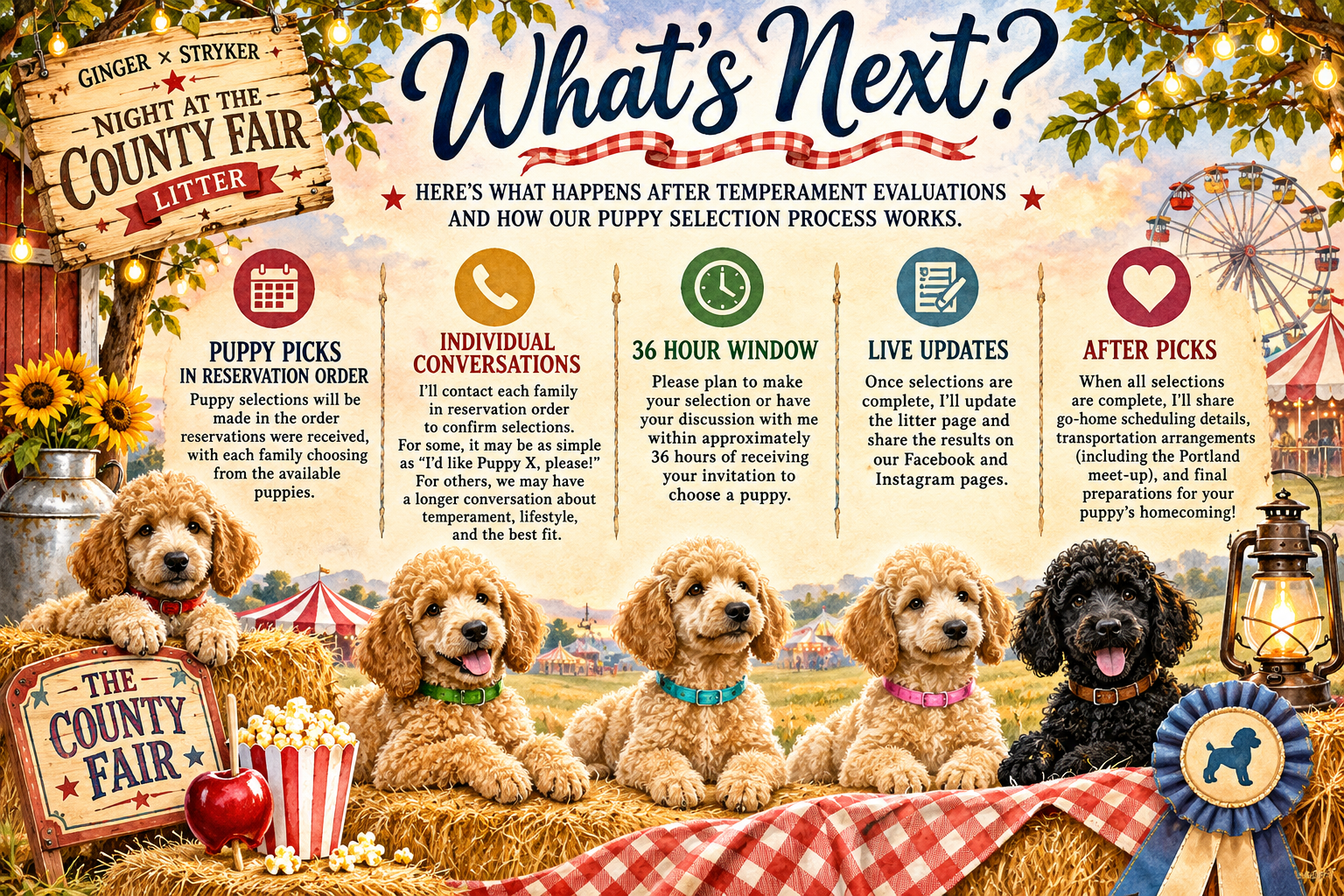
Puppy selections are made in the order reservations were received and commitments to the litter were established.
Our County Fair Litter selection order is as follows:
Valaurah Farms — Valerie Mitchem
Gordon Grochowsky
Terry Lush
Harini Kumar
Erica Adkisson
How the Selection Process Works
I'll be contacting families individually, in reservation order, to discuss and confirm their selections.
For some families, the decision may be as simple as:
"I'd like Puppy X, please!"
For others, we may need a longer conversation about temperament, lifestyle, training goals, and which puppy is most likely to be the right companion.
Either way, I'm happy to help you navigate the decision!
Please plan to make your selection or have your discussion with me within approximately 36 hours of receiving your invitation to select, so we can keep things moving smoothly for the families waiting behind you.
Following Along on the Midway
Our master temperament evaluation spreadsheet is live, and I'll update it as families make their selections.
As each puppy is chosen, I'll highlight that puppy's column to indicate they're no longer available. This allows everyone to follow along and see which of our five little fairgoers are still waiting for their ticket home.
I'll also share puppy selection announcements and updates on our Facebook and Instagram pages as families make their choices.
What Happens After Puppy Picks?
Once all reservation holders have completed their selections, I'll begin circling back to families who have been waiting in the wings, along with other approved applicants who may be a good match for any remaining puppies.
Any puppies still available after the reservation process will be offered on a first-come, first-served basis, with temperament and overall compatibility remaining important considerations.
The best part of a night at the county fair isn't always the rides, the games, or the lights. Sometimes, it's who you get to take home when the evening is over. I can't wait to see which families our five little fairgoers will be going home with! 🎡
Once our five little fairgoers have been matched with their families, it's time to pack up the midway and start planning their next big adventure—GO-HOME DAY! 🎡
Our County Fair puppies will be ready to head home beginning November 12th!
I'll be reaching out to each family to coordinate pickup and transportation arrangements, including our planned Portland meet-up on November 14th! Whenever possible, I like to combine trips when multiple puppies are heading in the same direction, so we'll work together to find a schedule that makes sense for everyone.
In the meantime, now is the perfect time to start getting everything ready for your newest family member!
Be sure to check out our Puppy Survival Guide. It's packed with information to help you prepare for those exciting first days and weeks together.
The rides may be winding down, the lights may be going out, and our little county fair may be coming to an end, but the best part of the adventure is just beginning—life together with your new best friend! 🎡❤️